
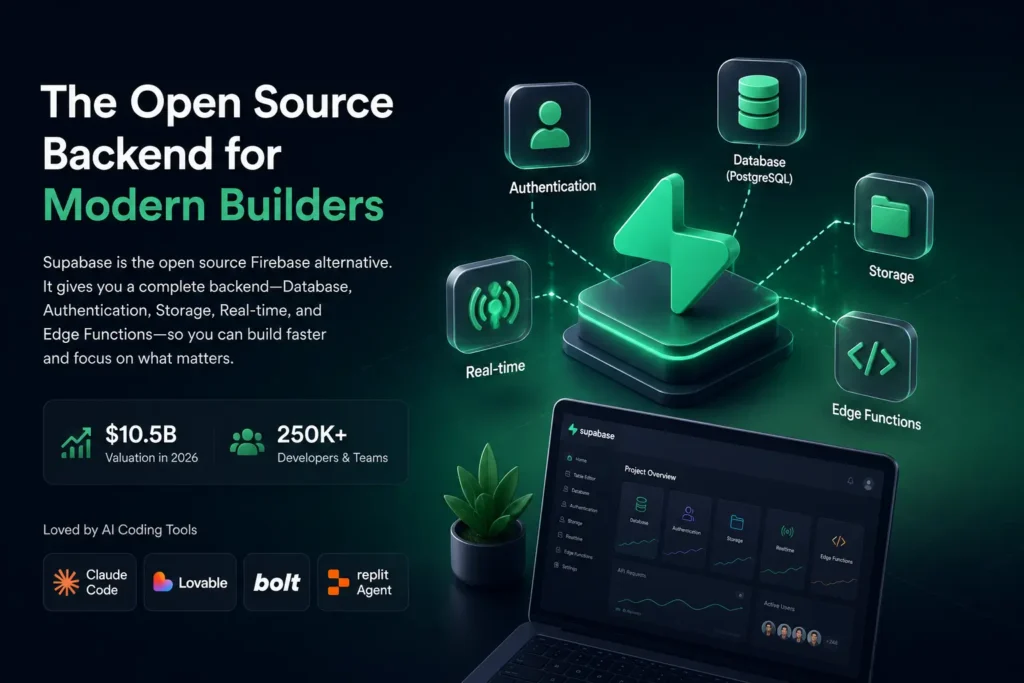
With the developer world in 2026 buzzing about AI coding, you’ve likely heard how Supabase plays a significant part. And now, it can’t be ignored. The open-source back-end system was backed by the massive growth of vibe coding, in which AI assistants such as Claude Code and OpenAI Codex generate apps from simple natural language queries and provision and automate a Supabase back-end database in the background, in particular powering the skyrocketing surge in the system’s valuation to $10.5 billion, a quadruple of its previous value in just 12 months. So let’s start to understand the basics: what the heck is Supabase, how does it operate, who is it for, and why are investors investing billions of dollars in this database startup? This guide makes it all simple, from basics to the $10.5bn story, in plain English for all.
What Is Supabase?
The Open-Source Firebase Alternative
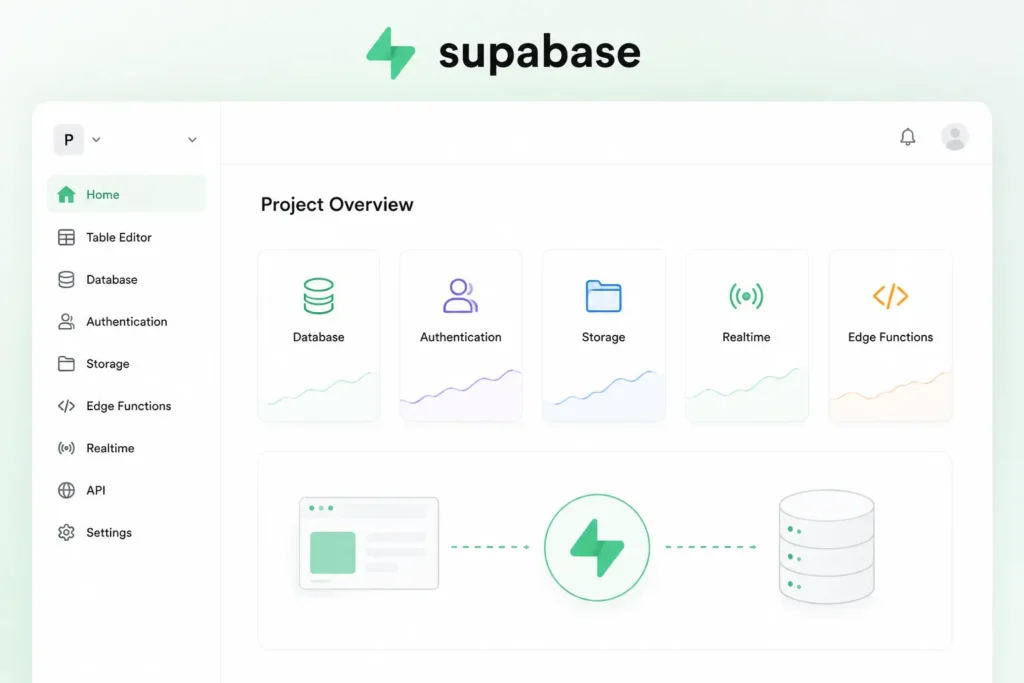
Supabase is an open-source API backend with everything a developer needs to build and deploy an App: Database, Authentication, File Storage, Real-time and Serverless Functions all in one place. It was established in 2020 by its CEO, PauCoppleston,e and CTO Ant Wilson, and is noted to be an open-source backend platform that competes with Firebase, which is Google’s favourite service. What sets them apart are their underlying databases: Firebase uses its own NoSQL (Firestore) while Supabase is 100% based on PostgreSQL, the world’s most trusted open-source relational database. With this ,,it’s easy to write standard SQL, your data can be moved around in various ways, and you will never be tied to just one vendor’s world.
Backend-as-a-Service, Explained Simply
Here’s how it’s easiest to explain it to non-developers. Whether it’s a social media app, a to-do list, an AI tool, or anything else, developers of apps also have to create backend and frontend components. No matter what kind of app is being developed, whether it’s the addition of a social media application, a to-do list, or an AI tool, there are back-end and front-end parts. It would take weeks to build a backend from scratch, involving server setup, configuring the database, security, etc.
Years ago, it would be weeks to create a backend, getting servers set up, configuring databases, security, etc. Supabase provides everything in one place. You sign up, create a project, and within minutes a full-featured backend with no server involvement to store data, logins, file uploads, live data updates, etc. You sign up, create a project and in a few minutes a full-featured, production backend without touching a server for data storage, logins, file uploads and even live data updates.
What Does Supabase Actually Include?
PostgreSQL Database
Every Supabase project comes with a complete PostgreSQL database. Unlike a document-based database like Firebase, PostgreSQL is a relational database, where data comes in tables with rows and columns, and complex queries enable the joining of multiple tables. This adds significantly more capabilities to Supabase for applications where social and structured data, multiple-step transactions, or complex filtering are required. Supabase also features built-in vector support to leverage the power of AI in areas such as recommendations, retrieval-augmented generation (RAG), and semantic search featuring in most AI coding tools in 2026.
Authentication
User authentication is built-in and included in Supabase. Developers can feature email and password sign-up and login flows, OAuth providers like Google and GitHub, phone logins, and magic links without writing any custom auth code. Always, users can only see the data they’re allowed to view by using a security feature at the database level, termed Row Level Security (RLS), which works in the same manner as the SQL implementation. All queries, regardless of whether they’re from the app or a background job or from a direct connection, pass through the same security layer, which is one of the more secure ways to serve a multi-user app’s backend.
Real-Time Subscriptions
Supabase also offers real-time database subscriptions, allowing your app to instantly update on-screen when data is changed in the back end without requiring the user to refresh. This comes in handy for chat apps, live dashboards, collaborative applications, and other applications that require them to see changes when. The real-time layer listens to a type of feed that sends internal updates to PostgreSQL; then, it transmits these changes over WebSockets to connected clients.
File Storage
The built-in file system helps the platform to organize images, videos, documents, and other resources. Files are stored in buckets that have access controls based on the same RLS policies associated with the database that is, the same access control rules apply to read or write access to a file. Fast global delivery via Supabase’s CDN.Fast global delivery via Supabase’s CDN directly from Storage.
Edge Functions
Small tasks like emails, credit card processing, and performing other server-running tasks can be achieved with server-running logic via Supabase’s Edge Functions: serverless TypeScript functions that deploy near the end-user to deliver low-latency, high-performance applications. Most architectures can do without a separate server or cloud function provider, which will be eliminated by the following.

Why Supabase Became the Backbone of Vibe Coding
What Is Vibe Coding?
Vibe coding aims to create apps entirely by providing AI tools with basic statements in the human language and letting the AI write the code, set up the database, and deploy the outcome. The tools that are driving this change include Lovable, Bolt, Replit Agent, and Anthropic’s Claude Code. Vibe coding becomes mainstream in 2026, allowing less technical founders to engage in coding and bringing down the ship speed for developers to an incredibly low level.
Claude Code Is Supabase’s Biggest Customer
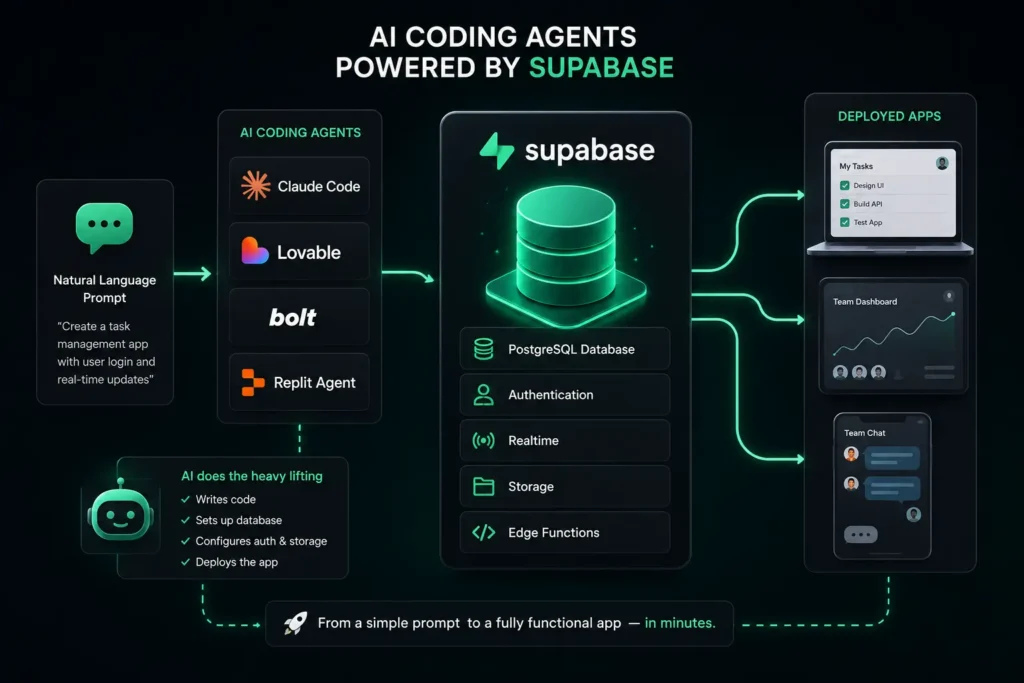
The $10.5 billion story now gets interesting. Paul Copplestone, the CEO of Supabase, says that AI coding agents currently make up the bulk of Supabase’s created databases, with Claude Code being the biggest one this year. When a developer builds an app using Claude Code, Claude will provision a Supabase backend automatically, write the schema, set up authentication, and configure storage. Each app developed using the user-made AI becomes an instant user of Supabase no effort required.
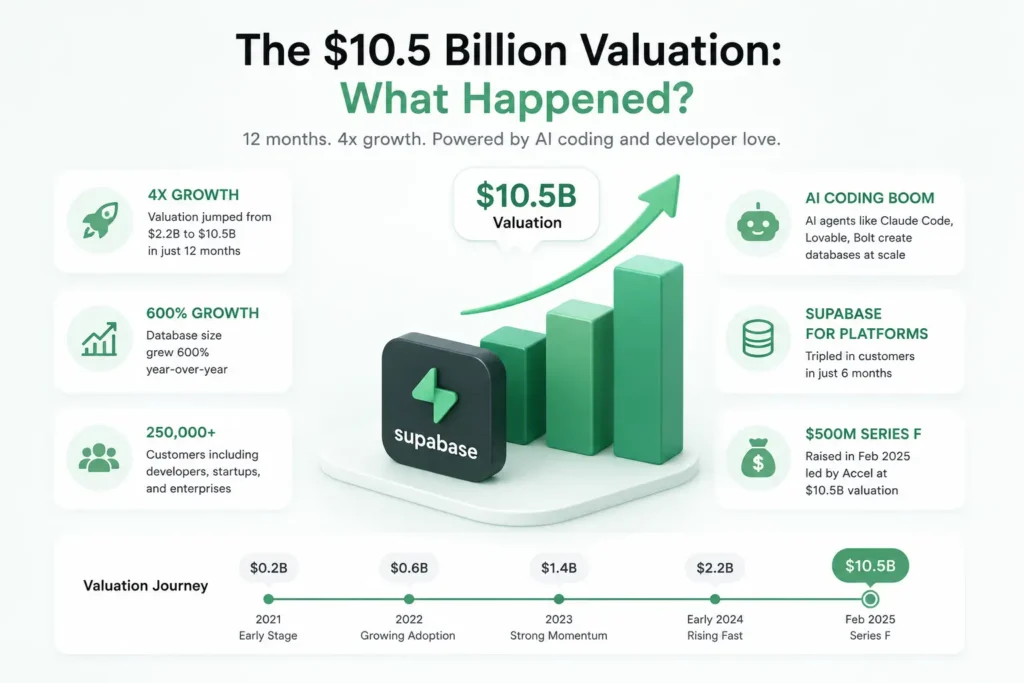
Between growth year-over-year, Supabase has grown its database size by 600%, and its Supabase for Platforms product which helps build platforms such as Lovable and Bolt has tripled in customer numbers in just six months. It is noahe developer growth feature. It’s not manually bulk-invitation by the devs. That is what the AI agent economy is doing on their behalf, on a large scale, making databases. That’s what the AI agent economy is doing on their behalf, on a large scale, creating databases.
Why AI Agents Choose Supabase
Three factors draw in AI coding tools to Supabase. First, it has clean documentation and is structured so that language models can reason about and use the platform well. Second, there is a lot of training data for PostgreSQL and SQL in AI models, so that AI models already know how to write queries, schemas, and policies for PostgreSQL and SQL. Thirdly, Supabase’s official MCP (Model Context Protocol) server has been released, which directly integrates Supabase with AI bots such as Claude to enable safe access to Supabase projects, bypassing the need for any workarounds. The outcome is a platform on which AI agents can reliably be used in an “at speed and repeatable” manner.
The $10.5 Billion Valuation: What Happened?
The Supabase company was created in 2020 and has been developed uninterruptedly by a group of developers. The valuation history wouldn’t show otherwise: From $6 million of seed funding in 2020, $30 million in 2021, $80 million in 2022, $80 million in 2024, and $200 million at a $2 billion valuation in 2025. Then, in June 202,,6 it raised $500m at $10.5bn, worth five times as much in less than a year. The Series F round was led by GIC with participation from Accel, Y Combinator, Craft, Felicis, Coatue, and Stripe. Today, the company has over 250,000 customers and 350 employees and still faces competition from the big database companies like MongoDB and Amazon Aurora. It also announced Multigres, another horizontal scaling tool in support of PostgreSQL, as part of the announcement.
Supabase vs Firebase: Key Differences in 2026
These are all backend platforms. They have different approaches to it, however. Let’s compare them on the most important factors.
| Feature | Supabase | Firebase |
|---|---|---|
| Database Type | PostgreSQL (relational, SQL) | Firestore (NoSQL, document-based) |
| Open Source | Yes — fully open source | No — proprietary Google service |
| Self-Hosting | Yes — Docker Compose is supported | No — Google Cloud only |
| Vendor Lock-In | Low — standard SQL, portable | High — proprietary query language |
| AI / Vector Search | Native pgvector support | Via Vertex AI (external) |
| Real-Time | Good (WebSockets) | Excellent (battle-tested) |
| Authentication | Built-in, RLS enforced at the DB level | Built-in, bypassed by Admin SDK |
| Free Tier | 500MB DB, 50K MAU, 1GB storage | Generous but usage-based billing |
| Pricing (Pro) | $25/month flat | Pay-as-you-go (can spike) |
| Best For | Web apps, SaaS, AI tools, vibe coding | Mobile apps, Google ecosystem projects |
The game-changers of 2026 are nothing short of the triumph of Supabase over AI-first development. To complete the above advantage, it has native pgvector support, MCP integration, a predictable pricing model, and an open-source base, which is reacting to this advantage with the new generation of AI-driven apps as the default backend. For mobile-first applications with a feature that requires offline capabilities or integration with Google’s ecosystem, Firebase may be a superior option.
Supabase Pricing: Is There a Free Plan?
Yes, for true learning, prototyping and small projects, Supabase provides a generous free tier that’s actually useful. The free plan comes with 500MB of database storage, 50,000 monthly active users, 1GB of file storage, and has no limits on hard usage like API requests. The Pro plan begins at $25 per month and is ideal for scalable production SaaS apps supporting up to 8K MAUs and then scales up. No charges for a limit of use, but rather fixed pricing and predictable costs this is a huge benefit over usage-based pricing with Firebase, which can cause charges to skyrocket on its busiest days.
Who Should Use Supabase?
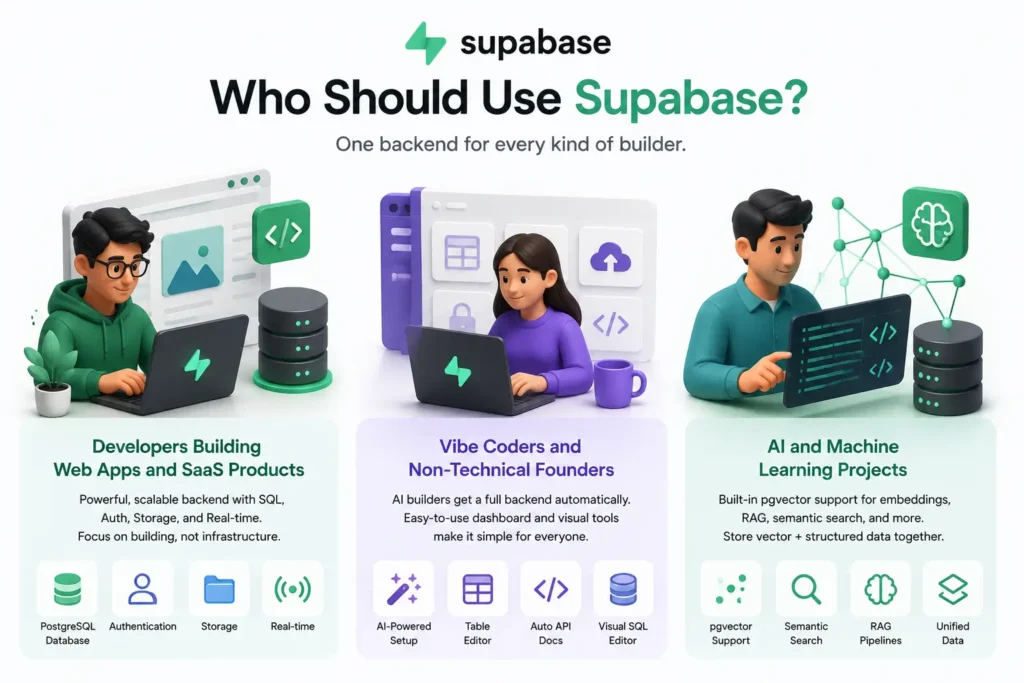
Developers Building Web Apps and SaaS Products
For web application developers who are familiar with SQL and don’t want to deal with infrastructure, Supabase is likely the best backend option. It places itself seamlessly into Next.js, React, Vue, and most up-to-date front-end frameworks. Relevant to multi-tenant SaaS (Software as a Service) applications, Row Level Security lets home-grown companies create data isolation at the database level, not the application layer.
Vibe Coders and Non-Technical Founders
If you are using the Claude Code, Lovable, Bolt, or any AI-driven app builder, Supabase will be provisioned in the background, likely. Founders who don’t wish to hack backend code themselves can easily leverage Supabase’s dashboard interface, where the table editor, auto-generated API documentation, and visual SQL editor make basic actions attainable even if you don’t have deep exposure to the database.
AI and Machine Learning Projects
Native support for pgvector brings simplicity to embedding storage, RAG pipelines, and semantic search, further solidifying Supabase’s status as the best AI tool for embedding applications. With native support for pgvector, Supabase is a perfect fit for embedding applications, suchasm AI applications like semantic search, RAG pipelines, and embedding storage. Each team can store embeddings together with its structured data on a single instance of PostgreSQL, streamlining the architecture and drastically lowering infrastructure expenses.
Honest Pros and Cons of Supabase
Pros
- No vendor lock-in; your data remains portable: Open source and self-hostable; no vendor lock-in.
- Based on PostgreSQL, the most-used and trusted relational database around the world.
- Delivers native support for AI readiness for pgvector semantic search and RAG applications.
- No hidden costs or unexpected charges — flat rates begin at $25/month
- Official integration with the MCP server allows the integration of AI agents for native management.
- Free tier has a genuine use – there’s more than a demo limit.
- Database level, and not application level costing, Row Level Security.
Cons
- Real-time features are there, but are not as well-tested or battle-tested as the одного Firebase has using WebSockets.
- Self-hosting takes some technical expertise and maintenance.
- Unlike NoSQL, the SQL requirement is a tougher curve to negotiate for developers who are familiar with more flexibility.
- Ecosystem is smaller than or as large as Firebase’s, which was also founded in 2011
- To upgrade to a higher-elevation plan, users must use manual database instance upgrades.
Conclusion
Supabase was originally developed as a standard way to use less complicated than Firebase and has grown quietly into the backbone of the coding era of artificial intelligence. Valuing at $10.5 billion isn’t just a mark of a startup it’s an indicator of where the “picks and shovels” of the vibe coding revolution are going in ‘26.’ If you’re a developer thinking of creating your next SaaS product, a non-technical founder who’s using Claude to build an app, or merely an AI fan wondering where the AI industry is going next, Supabase’s name is on the tip of your tongue. It is open source, it is fast, it is AI-native, and at this moment, it is at the core of the building of the next generation of software.
Also Read : Best AI Smart Glasses in 2026: Top Picks for Productivity, Travel, and Everyday Use
10 Best Free AI Tools for Homework Help That Students Actually Use
Frequently Asked Questions
What is Supabase used for?
Embeds its Web and mobile applications on Supabase, a backend platform built on open-source technology that supports databases, user authentication, file storage, and real-time capabilities PAs do not have to build and manage servers to power Web and mobile applications.
Is Supabase free to use?
Yes. The Supabase free tier includes free database storage of 500MB, 50,000 monthly active users, and free file storage of 1GB — ideal for learning, side projects, or prototyping.
Is Supabase better than Firebase?
Currently, SaaS products, web apps, and AI-powered apps have a decided advantage over Supabase because of its free and open-source foundation as a PostgreSQL database (Postgres), as well as its predictable pricing. Firebase still works best for mobile apps that need to work offline or have tight integration with Google services.
Why is Supabase so popular with AI tools in 2026?
AI coding agents such as Claude Code favor Supabase due to its clean documentation, well-represented SQL in its training data, and official support for an anana MCP server for direct integration with AI agents, making automated app-building easy.
What is vibe coding, and how does Supabase fit in?
Vibe coding involves coding apps by using text prompts with AI-powered tools such as Claude Code or Lovable. When you build your app with an AI, Supabase will power it, too — this includes the automatic provisioning of a Supabase database.
Is Supabase open source?
Yes. The server-side code for Supabase is available at a free open-source repository on GitHub, which is licensed under the Apache 2.0 license, and you can host your entire system on your own if you want ultimate control over your infrastructure by running it yourself, using Docker Compose.
What is Supabase’s valuation in 2026?
In June 2026, Supabase “raised” $500 million in a Series F round with a valuation of $10.5 billion, which was led by the GIC, with many others having an interest.
Can non-developers use Supabase?
Yes, with AI tools such as Lovable and Bolt, which have Supabase as their backend. The dashboard is also user-friendly for data processing for simple use, while if you want to use advanced SQL, is required knowledge.