Occasionally, when you enter a video call with three or more people, there’s something that is set into motion in the background. That thing is called a multipoint control unit (MCU), Most users and everyday consumers who depend on it have never heard its name! That’s sort of the way it’s supposed to be: If it performs as expected, you don’t notice it. However, remove it from the equation, and multi-participant video conferencing goes out the window.
By 2026, when hybrid working becomes standard across all industries, and collaborative teams remain connected throughout the globe across continents, the MCU, which remains one of the most important yet little-in-the-know enterprise communications elements has quietly slipped into criticality. Here are the details on precisely what an MCU is, its evolution from proprietary rack-based hardware to cloud-based software, how it compares with the SFU-based architectures it’s replacing in certain workplaces, what vendors offer what, and most crucial to you: when you should consider deploying an MCU. At the end, you’ll have a clear, practical structure to confidently make that call.
1. What Exactly Is a Multipoint Control Unit?
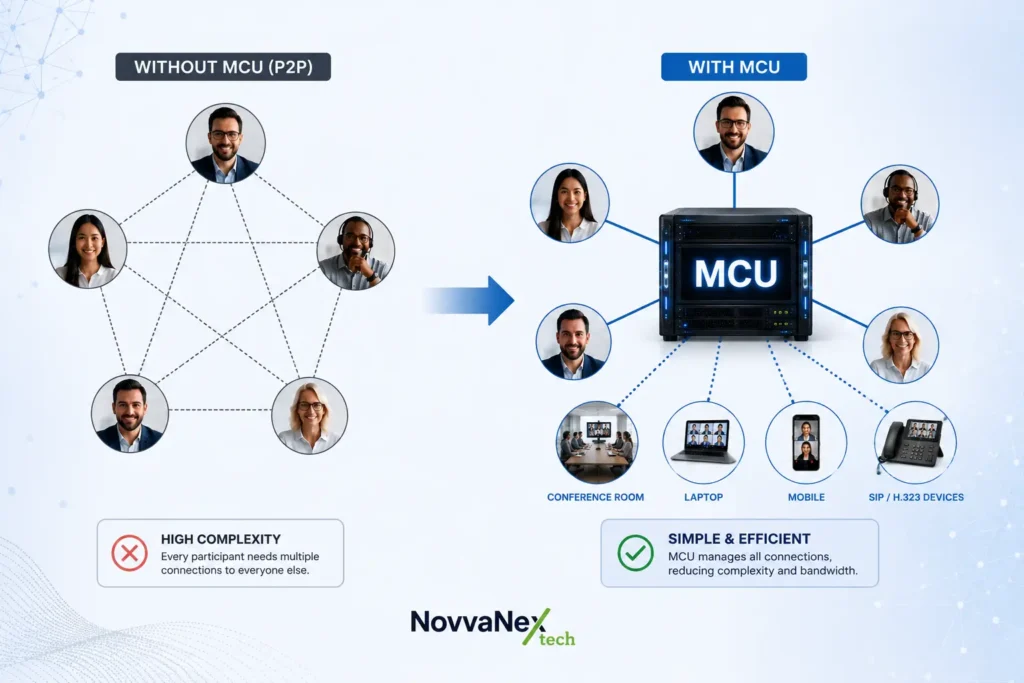
Ditch the jargon, and what you have is the MCU concept in a nutshell. It is a separate hardware device or software tool that enables groups of three or more endpoints to be linked into a virtual meeting. It’s like a conference switchboard, just that it’s handling dozens to hundreds or more people at the same time, streaming audio and video.
Before the introduction of the MCU, the only way to conduct video calls was between two people. It’s two locations, a single connection. What changed was the ability to facilitate multi-party calls, via centralized media mixing, allowing the audio, video, and data from any endpoints to be combined into a single stream that’s subsequently sent back to all parties involved.
It’s the classic split-screen grid you’ve witnessed in every video call.It’s the same “always-observed split-screen grid” you’ve seen in every video call. The MCU built that. If the mode is Continuous, the screen will be split into one large window for the dominant speaker, and multiple smaller windows for the rest. All that layout logic is done automatically and in real time by the MCU.
2. How the MCU Processes Audio and Video Streams
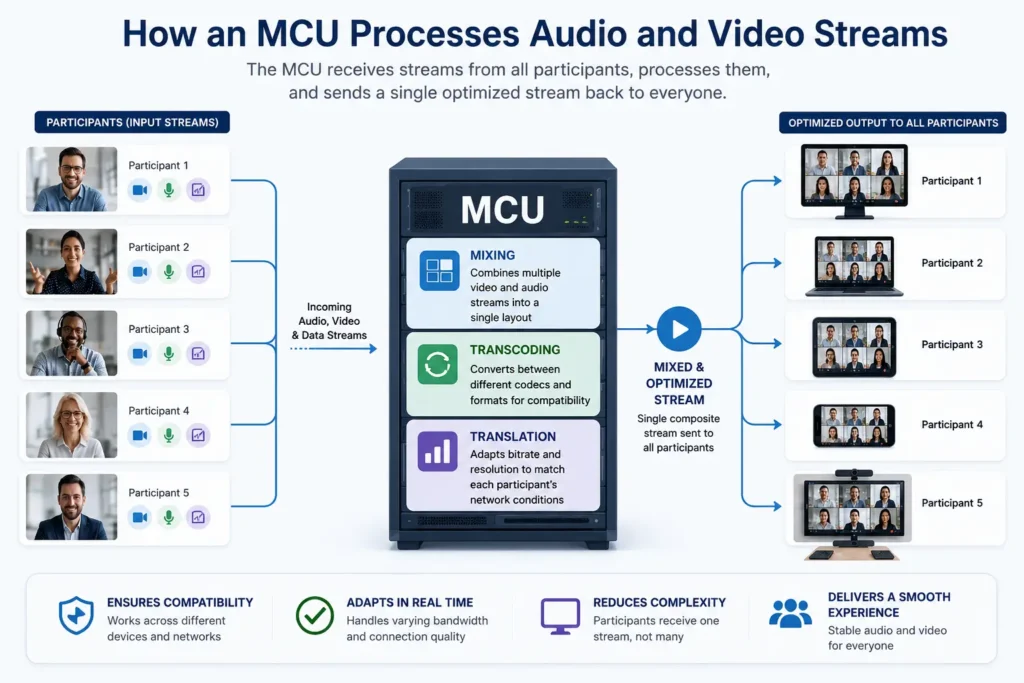
The MCU does not simply relay feeds it actively processes them. Each participant’s audio, video, and data streams arrive at the MCU, where they undergo three core operations before being sent back out:
- Mixing combining multiple video feeds into a single composite layout that all participants receive simultaneously.
- Transcoding converting video from one format or codec to another so devices running different standards can communicate.
- Translating adjusting the data rate of a video stream to match available bandwidth conditions per participant.
This adaptive processing keeps a call stable when one participant is on fiber and another is on a shaky mobile connection. The MCU absorbs the inconsistency and delivers a normalized output to everyone on the call.
3. The Mesh Network Problem MCUs Solve
In a classic P2P model, each participant has to make point-to-point connections with every other participant. This results in bandwidth overhead growing squarely based on the number of machines (Nx(N-1)). This changes from 380 individual connections to merely 20 connections for a 20-person call set-up.
| Participants | P2P Connections | MCU Connections | Reduction |
|---|---|---|---|
| 4 | 12 | 4 | 67% |
| 10 | 90 | 10 | 89% |
| 20 | 380 | 20 | 95% |
| 50 | 2,450 | 50 | 98% |
4. The Two Core Components Inside an MCU
Multipoint Controller (MC) Brain. Manages the signaling layer, which is H.323 or SIP protocols used to establish, maintain, and disassociate the connection. Determines what capabilities can be shared between endpoints, maintains a conference list of participants, and defines how to mix audio and lay out video.
MP (Multipoint Processor) Muscles. Properly decodes incoming streams, mixes and switches them, re-encodes the result, and delivers it to the outside world. The MC thinks and does; the MP does.
When troubleshooting, that division is important! The MC is to blame for signaling issues. If there is an audio or video quality problem, it is the responsibility of the MP.
5. From Hardware Rooms to the Cloud: MCU Evolution
The last 10 years of the MCU have undergone more changes than the last two. The turning point came when scalable RISC architectures were replaced by standard x86 servers. A dedicated rack appliance, which once cost tens of thousands of dollars, can now be used as a cloud appliance for a small fraction of the price.
6. MCU vs SFU: Performance Data and Real Trade-Offs
So, for network architects in 2026, the answer to the question may be more about whether to continue using an MCU, rather than what it is. However, for budget and latency, SFUs account for cloud-native deployments. However, the metrics are not enough: device capability and compliance needs make all the difference.
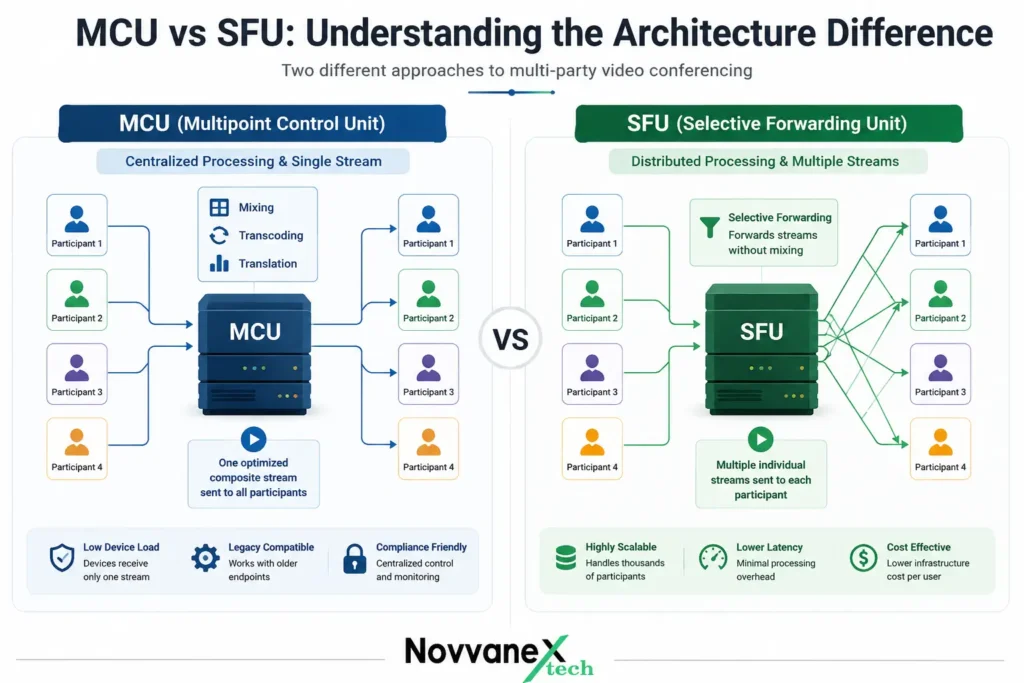
| Metric | MCU | SFU |
|---|---|---|
| Infrastructure Cost (per 1k users/mo) | $2,000–$5,000 | $300–$500 |
| Network Latency | 200–400 ms | 100–200 ms |
| Video Quality Score (VMAF) | 60.3 | 70.2 |
| Peak PSNR | 35.2 dB | 40.1 dB |
| Average Frame Rate | 28.4 FPS | 32.1 FPS |
| Client-Side Processing Load | Low | High |
| Legacy Endpoint Compatibility | Excellent | Poor |
For an SFU model all of the end-point devices will get several streams, and each will draw its own layout locally. That client side burden is really an issue in the locked down room system or on low-powered enterprise device. The MCU model decreases the requirements of the client devices to a minimum by doing most of the work on the server.
7. Real Vendor Landscape: Who Uses What in 2026
The trend goes on and on pure-cloud consumer platforms go the SFU way. Regulated industries or legacy room hardware enterprise platforms have MCU capability typically in a hybrid configuration model.
| Vendor / Platform | Architecture | Notes |
|---|---|---|
| Cisco (Webex) | Hybrid MCU + SFU | On-prem MCU-heavy; cloud uses SFU for scale |
| Poly (HP) | Hardware MCU | Room systems; legacy H.323 focus |
| Pexip | Software MCU | SIP/H.323 to WebRTC bridging specialist |
| Microsoft Teams | SFU + MCU bridging | SFU for standard users; MCU for legacy rooms |
| Zoom | SFU-primary | MCU is used for a telephony bridge only |
| TrueConf | Software MCU | On-premises; strong in regulated industries |
| AWS Chime SDK | Configurable | Developer-facing; MCU mode for compliance |
8. Security and Compliance: Where MCUs Still Win
The centralized approach of the MCU is not a constraint for regulated companies; it’s a quality. Media will pass through a media control unit (MCU) server, which can then be encrypted, logged, audited, and controlled at a single point of enforcement.
- Accessing patient video consultations, HIPAA (Healthcare), needs to be end-to-end encrypted and audited. An MCU that runs within the company’s network will fulfill data residency requirements that cloud SFU services often cannot.
- GDPR (Europe): Data sovereignty regulations call for communications not to cross the borders of countries outside of Europe on servers. On-premises MCU deployments fix this right away.
- Hardware-based security configurations are mandatory when meeting on the classified Internet, and media should never penetrate the public Internet when using classified conferencing.
9. WebRTC and the MCU: How They Interact
Browser based video calling: Google Meet, browser based Zoom and virtually all no plug-in required web conferencing platforms are enabled by WebRTC. Is designed to be SFU-friendly. However, there are a variety of legacy enterprise endpoints, such as the Cisco room systems, Poly systems, and H.323 conference phones that don’t natively communicate WebRTC.
If a WebRTC participant arrives at a WebRTC call where there is also a legacy device, it will certainly need some mechanism to fill the void. This is normally an MCU or a purpose-built MCU gateway. Pexip is a dedicated product for just this, stripping out the options of taking WebRTC streams from elements involved in a browser and H.323/SIP streams from room elements and integrating both streams at an MCU layer so that everyone sees and hears each other.
10. How to Choose: MCU, SFU, or Hybrid?
You need the right architecture for your environment. Apply this decision-making process:
| Requirement | Best Choice | Why |
|---|---|---|
| Legacy H.323/SIP endpoints | MCU | Only architecture that natively transcodes legacy protocols |
| HIPAA / GDPR compliance | MCU | Centralized audit point, data residency control |
| 10,000+ cloud participants | SFU | Linear scaling, low server cost per user |
| Low-powered endpoint devices | MCU | The server does the heavy lifting; the device gets one stream |
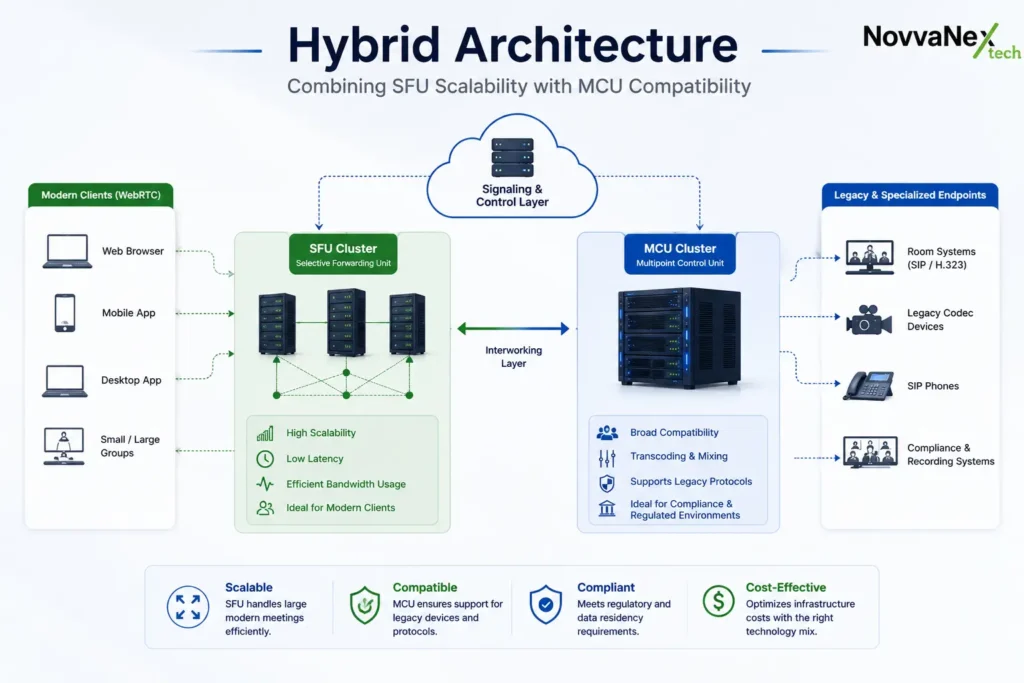
| Mixed legacy + cloud users | Hybrid | SFU for cloud users, MCU nodes for edge cases |
| Live broadcast/recording | MCU | Centralized mixing for broadcast-quality output |
In 2026, most enterprise environments will be classified as hybrid. The scale is in the hands of the SFU, and exceptions are in the hands of the MCU but it’s the age-old exception we care about the most.
11. Real-World Use Cases Where MCUs Remain the Right Call
Government & Defense Air-gapped networks, hardware-enforced security boundaries, and classified-grade encryption. Only isolated infrastructure provide a compliant software MCU option.
- Telemedicine in Healthcare: Multi-site clinical consultation between various healthcare systems that operate different video systems. Having incompatible endpoints is a problem for the MCU, but not for the SFU.
- Broadcast and Live Production: MCU-based centralized mixing provides output quality suitable for broadcast or live streaming and recording. There is a special “compositor” functionality that is designed for this workflow.
- Organized Companies Running Legacy H.323: Companies that have dedicated systems for conference rooms do not need to abandon this investment and need not overlook the utility of the legacy H.323 systems. An MCU (Detector Controlled Accuracy) connects them with today’s calls without a rip-and-replace project.
12. The Outlook for MCU Technology in 2026 and Beyond
The MCU isn’t coming to an end as much as it’s shaping up for the future. Premise or hardware-based options are becoming a thing of the past. But, the concept of centralized media processing, mixing, and distribution is being incorporated into cloud platforms and hybrid concepts without being completely given up.
The future of AI integration awaits. Voice and visual recognition is supplying the MCU with source control capabilities and automatically switching its focus, modifying layouts and even blocking background noise, and early deployments show AI-assisted mixing is no longer an experiment, but a production-ready technology.
Platform developers and network engineers have no view of a single answer for platform development, and it’s seldomana MCU orana SFU choice. Conferencing solutions from standard cloud to legacy infrastructure and ba,ck or complimentary endpoints are converging toward hybrid architecture, leveraging SFU architectures while allowing legacy or compliance endpoints to be bridged by MCU nodes.
Conclusion
The multipoint control unit is not relics, it keeps on reinventing itself as an infrastructure that is still important and still going. Yes, it’s no longer the era of hardware-only. The role it plays in centralizing, mixing, transcoding, and distributing media between incompatible endpoints is pertinent today just as it was when the first rack-mounted media processor turned on in the 1990s.The MCU is also appropriate for those who prefer to continue using an old room system, are subject to a compliance requirement, or wish to sing their recordings but are not in the business of broadcasting high-quality recorded output, for a lack of sentiment. The SFU loses on cost and scale when the organizations only have to pay for the cloud licensing and scale it up in proportion to their physical and virtual footprint. For the vast majority of others somewhere between these two points, a middle-ground option can exist where the two architectures merge in not quite as bizarre a way as it might sound.
But understanding the MCU is in no way historical context. It is the base for infrastructure decisions which will be scalable, compatible, and last long after the next platform trend.
Also Explore : Tikcotech | What It Actually Is, What It Covers, and Whether It’s Worth Your Time in 2026
Frequently Asked Questions
What does a multipoint control unit actually do in a video call?
It takes audio and video streams from all the participants, combines them (and optionally switches them) to a common output, and passes that output to all endpoints. All this allows multiple users to conference without each device having to connect instantly with all other devices.
Is an MCU the same as a conference bridge?
Yes, in a functional way, the words are used interchangeably. The MCU is the specific piece of hardware or software that directly implements the bridging part of the conference bridge, while the conference bridge itself is the overall idea.
Why are SFUs replacing MCUs in many modern platforms?
SFUs don’t mix or transcode streams, just select them forward, which means it’s not that complicated to implement and is scalable at a very low bid to thousands of players. In cloud-native platforms which are more interested in their scale and cost, SFU is more practical.
When should an organization still choose an MCU over an SFU?
Where legacy endpoint compatibility is needed, regulatory requirements require centralized processing and auditability, broadcast of mixed output is desirable or participant devices are not a capable of processing multiple input streams on site etc.
Can MCU and SFU architectures coexist in the same system?
Granted and this is more and more frequent. There are hybrids like the Microsoft Teams platform and AWS Chime SDK, which process standard cloud-based participants through the SFU and legacy room systems or compliance-specific endpoints (MCU).
What is cascading in MCU architecture?
Cascading is the process of linking several MCU servers to get a conference on a larger scale than one MCU can handle. Most legacy hardware MCUs could be used by only about 25 simultaneous visible learners and cascading added more participants.