
The advent of AI is transforming the way we interact with technology, and smart glasses are one of the most promising examples. It began as a cool wearable technology but has grown to become a usable communication, content creation, navigation, translation, and hands-free way to access AI technology.
AI smart glasses are not futuristic gadgets anymore and in 2026, they are no longer a novelty for tech enthusiasts. The modern models know how to reply, recognize objects, understand what you’re talking about and share it with you, take photos, help you find your way around and even print out information right in your sight. Nowadays, there are various options available to consumers thanks to the heavy investments made by big companies in the development of wearable AI.
But it’s not always an easy decision to make. Some smart glasses emphasize the artificial intelligence functionality of voice assistance, while others focus on the augmented reality screenings, work productivity capabilities, or the immersive experience of entertainment. The appropriate choice is determined by their intended use.
To help you choose the best AI smart glasses available in 2026, this guide will explore the strengths and weaknesses of the top options and what they’re best suited for.
Quick Comparison Table
| Smart Glasses | Best For | AI Features | Display | Camera |
|---|---|---|---|---|
| Ray-Ban Meta Smart Glasses | Overall Best | Meta AI, voice assistant, visual AI | No | Yes |
| XREAL One | Productivity | AI-enhanced workspace tools | Yes | Limited |
| Even Realities G1 | Everyday Wear | Notifications, translation, navigation | Yes | No |
| VITURE Pro XR | Entertainment | Smart assistant integration | Yes | No |
| Solos AirGo V2 | Advanced AI Features | ChatGPT, Gemini, Claude support | Optional | Yes |
| Halliday AI Glasses | Emerging Innovation | Context-aware AI assistance | Yes | Limited |
What Are AI Smart Glasses?
AI smart glasses are a combination of wearable technology and artificial intelligence to deliver hands-free access to digital information and AI-powered features. These devices can take photos and translate languages, show relevant info, process voice commands, and interface with AI assistants, unlike regular glasses.
A lot of the latest, high-tech AI glasses are based on a few technologies combined:
- Artificial intelligence assistants
- Computer vision systems
- Voice recognition
- Real-time language processing
- Identify ways to navigate and locate items on a map. Plan and locate on a map.
- Wireless connectivity
With varying models, users can also pose questions, get directions, summarize information, tell a landmark, or communicate with applications without having to constantly pull out their smartphone.
Convenience is the greatest benefit. Users no longer have to reach for a phone to get information, but can instead voice command and see the information come to them.
1. Ray-Ban Meta Smart Glasses – Best Overall AI Smart Glasses in 2026
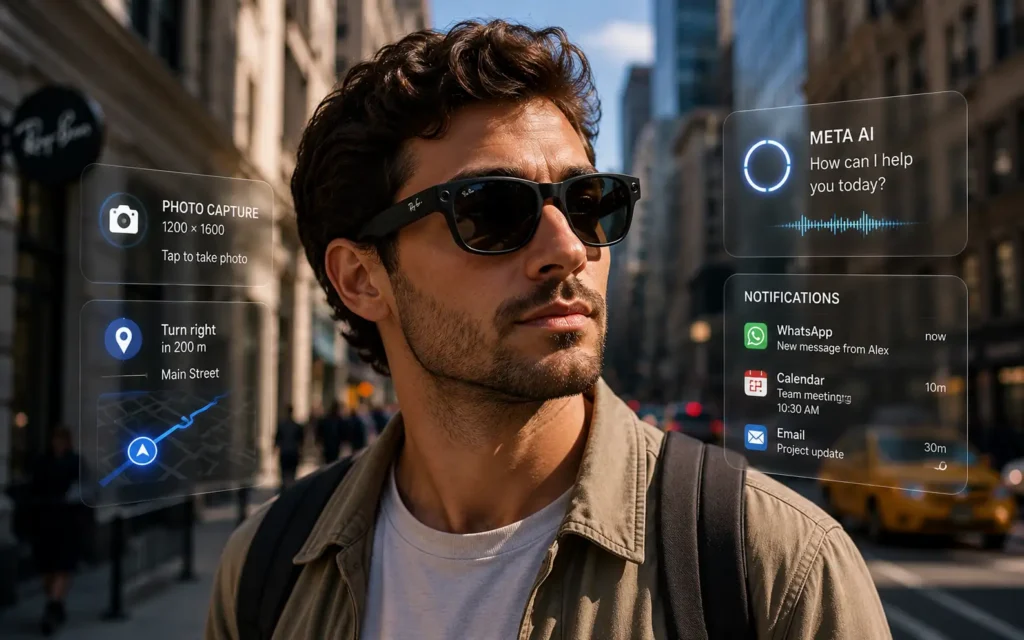
Ray-Ban Meta Smart Glasses still reign supreme in the AI smart glasses market in 2026. What makes them so successful is that they’re able to meld an already-established eyewear aesthetic with functional artificial intelligence capabilities that are actually applicable to everyday life.
These glasses look very similar to the regular Ray-Ban frames, and they’re not that bulky. This makes them one of the easiest smart glasses to wear for any situation, professional, social, or casual.
Key Features
- Integrated with Meta AI assistant.
- High-quality camera system
- Voice-controlled operation
- Live translation capabilities
- Music and call assistance
- No more holding a camera!
Pros
- Stylish and socially acceptable design
- Excellent camera quality
- Integrated with a strong AI assistant.Strong AI Assistant Integration.
- Easily worn with every day of your life.
- Easy smartphone connectivity
Cons
- No built-in display
- These AI features need some online connectivity
- May not endure with heavy usage
Best For
Users seeking the best of its design, usability, and functionality, balanced with its AI features.
Why It Stands Out
There are many smart glasses that do great things in one aspect and are not so great in another aspect. Ray-Ban Meta glasses provide a comprehensive experience suitable for content creators, travellers, professionals and regular users. Most buyers in 2026 will benefit most from the multi-modal capabilities of visual AI, voice assistance, and camera.
2. XREAL One – Best AI Smart Glasses for Productivity
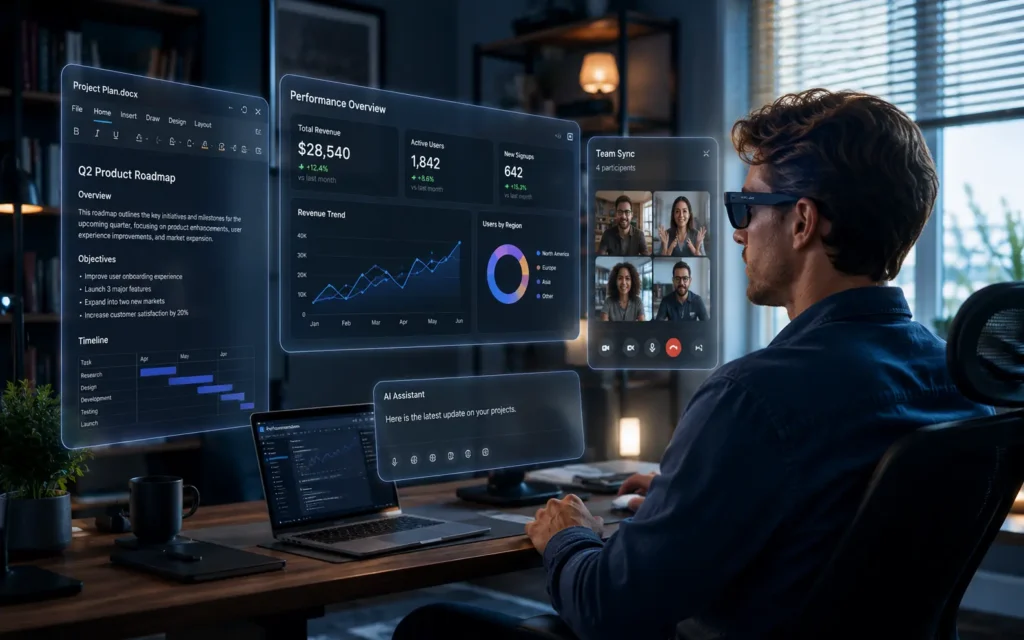
With its robust features and seamless integration, XREAL One has become one of the greatest smart glasses experiences available for professionals, remote workers, and productivity-focused users.
Unlike most of the smartphones that have been centered on photography or social media features, XREAL One is built to provide a mobile digital workspace. From documents to spreadsheets, presentations to multimedia, the glasses can create a much larger virtual display so that users can work in a more immersive environment.
Key Features
- Great large-screen viewing experience.
- Productivity-focused interface
- Enhanced screen privacy
- Lightweight design
- Multi-screen workspace support
- High-quality visual output
Pros
- It provides a superb virtual workspace experience. It offers a great virtual workspace experience.
- Sharp display quality
- A good option for traveling and working away from home.
- Better than conventional monitors
Cons
- The learning curve is the slope’s steepness for users who are new to the software.
- More expensive than other options.
- It will need suitable devices to be fully functional
Best For
Professionals, students, nomads, and remote workers seeking a convenient productivity tool.
Why It Stands Out
Traditional laptop and tablet devices are effective, but XREAL One offers a new approach to work. Rather than the size of the physical screen, users can access a bigger virtual screen that can enhance multitasking and productivity when traveling or working remotely.
3. Even Realities G1 – Best AI Smart Glasses for Everyday Wear

In most cases, smart glasses have one downside: they are like high-tech products, not regular glasses.
Even Realities G1 deals exceptionally with this challenge. The glasses aim to seamlessly incorporate into everyday wear while subtly providing practical smart electronics.
Key Features
- Minimalist design
- Real-time translation support
- Smart notifications
- Navigation assistance
- Lightweight construction
- Subtle information display
Pros
- It resembles ordinary glasses. Has the appearance of standard glasses.
- Long-lasting and comfortable to wear.
- Useful everyday features
- Discreet smart functionality
Cons
- Limited entertainment capabilities
- AR competition wants a display size and a smaller display than AR competition products.
- Not as good for immersive experience
Best For
Users experiencing a need for smart features, without drawing attention or wearing bulky technology.
Why It Stands Out
The most significant advantage of Even Realities G1 is the practical advantage. It doesn’t attempt to replace smartphones or laptops; it’s a subtle enhancement to daily activities with subtle AI assistance that feels natural and unobtrusive.
4. VITURE Pro XR – Best AI Smart Glasses for Entertainment
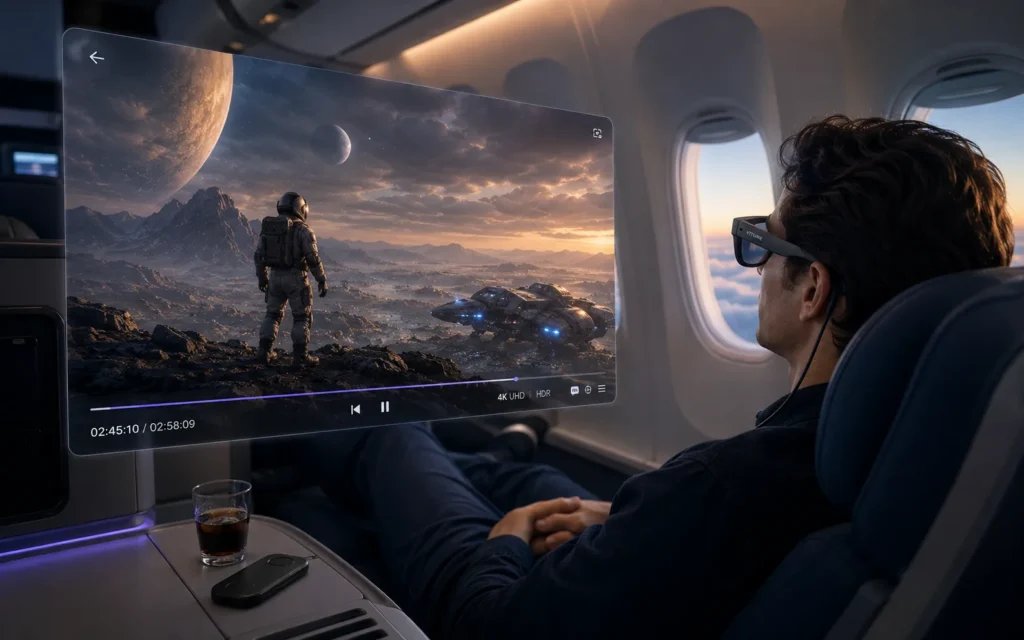
VITURE Pro XR is one of the top choices for 2026 if you’re looking for entertainment, media, and immersive viewing experiences.
VITURE Pro XR isn’t like smart glasses, which are primarily dedicated to AI assistance or photography, but rather offers a sizeable virtual screen field of view. These glasses can be used for watching movies on a flight, playing games at a hotel, or watching movies at home – and they create a more immersive experience than watching on a smartphone or tablet.
Key Features
- Large virtual display
- XR entertainment platform
- Gaming support
- High-quality visual experience
- Portable media consumption
- Comfortable long-session viewing
Pros
- Great for watching movies and streaming.
- Great gaming experience
- The use of smaller screens is an alternative to larger displays that can be moved.
- High-quality visuals
Cons
- Less focused on AI functionality
- Not recommended for users who want to work efficiently.
- Premium pricing
Best For
It is designed for travelers, gamers, film buffs, or any user who wishes to have their own entertainment display.
Why It Stands Out
VITURE Pro XR is unique in its emphasis on an unparalleled entertainment experience, while most smart glasses want to be everything. This specialization is a great choice for anyone who spends long periods watching media.
5. Solos AirGo V2 – Best AI Features
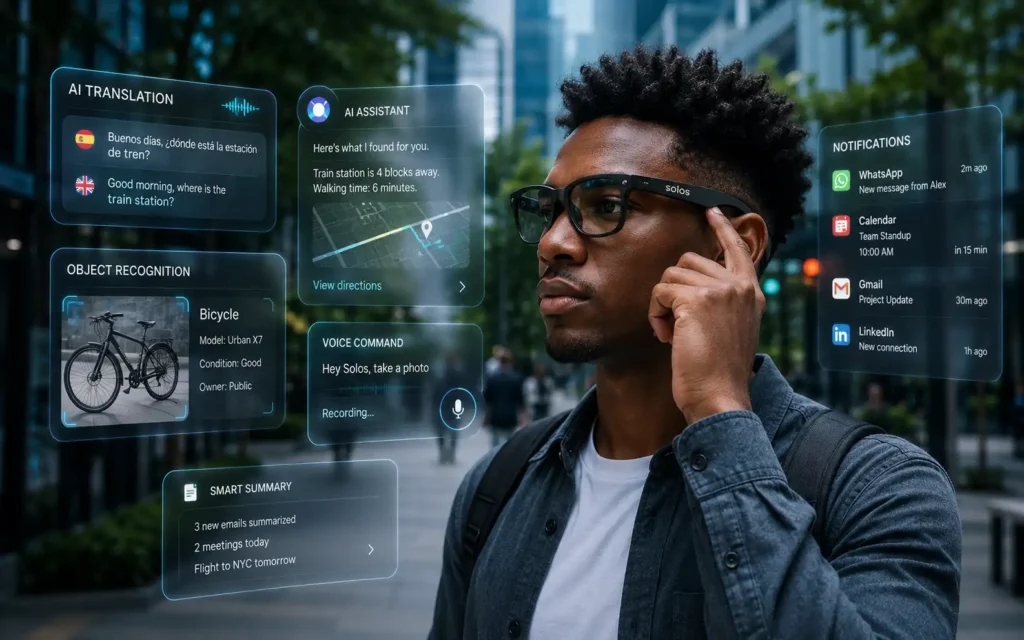
Unlike Solos AirGo V2, which puts artificial intelligence in the middle, there is a fundamental difference in approach. These glasses are designed around AI-based interactions, rather than being built for the AI per se.
One of the major selling points is its ability to support multiple AI models. The platform offers greater flexibility than many offerings, with users having the option to choose which AI assistant to use depending on their preferred workflows and preferences.
Key Features
- Multi-AI assistant support
- Visual recognition capabilities
- Real-time information retrieval
- Voice-first interaction
- Smart notifications
- Translation features
Pros
- Strong AI ecosystem
- Advanced voice interactions
- Useful translation tools
- Flexible assistant options
Cons
- While design can be visually pleasing to some, others may not find it all that attractive.
- Certain features are dependent on access to the cloud.
- Flow duration is determined by the use pattern and varies with use.
Best For
Tech enthusiasts, AI heavy users, frequent travellers, and digital assistant users.
Why It Stands Out
As AI gains more power, wearable devices are more and more morphing into personal assistants. One of the most AI-driven products in this category is Solos AirGo V2, which is an attractive option for those who are looking for top-of-the-line.
6. Halliday AI Glasses – Best Emerging Option
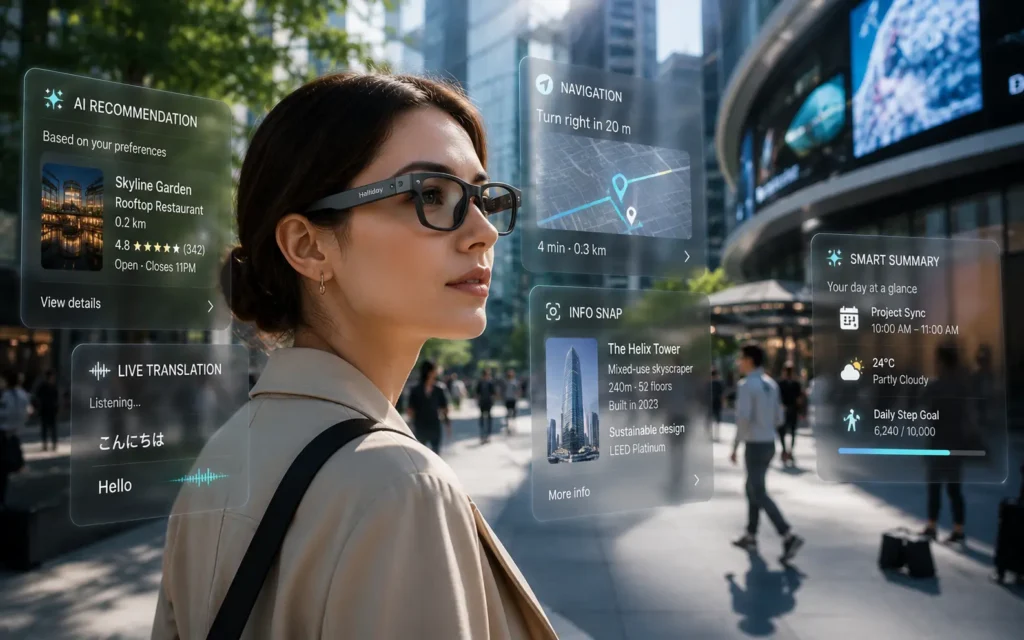
Halliday AI Glasses are a new generation of wearable AI. They may not be as well-known as larger companies, but they demonstrate the direction in which the industry is going.
Instead of just reacting to commands, these glasses focus on contextual help — giving those the information they need, when they need it.
Key Features
- Context-aware AI support
- Lightweight design
- Smart notifications
- Navigation assistance
- Productivity enhancements
- Wearable AI integration
Pros
- Innovative AI features
- Comfortable design
- Forward-looking technology
- Strong future potential
Cons
- Smaller ecosystem
- Fewer third-party integrations
- Not fully developed in comparison to the more established players
Best For
Early adopters, users interested in the future of wearable AI technology.
Why It Stands Out
While not necessarily the best investment for all consumers, Halliday AI Glasses are a preview of wearable tech’s future in the years to come. What they’re really aiming for is proactive AI support, which is intriguing for those who desire beyond simply voice commands.
How to Choose the Best AI Smart Glasses
As there are many options, choosing the best AI smart glasses should be based on your preferences.
Choose Based on Your Primary Use Case
Everyday Use:
Ray-Ban Meta Smart Glasses and Even Realities G1 glasses provide an ideal blend of style and utility.
Productivity:
XREAL One is the best virtual workspace solution.
Entertainment:
VITURE Pro XR is perfect for movies, streaming and gaming.
Advanced AI Features:
Solos AirGo V2 is one of the most AI-driven experiences on the market.
Innovation and Future Potential:
Halliday AI Glasses are worth considering for early adopters.
Key Factors to Consider
AI Capabilities
An AI system is not the same as a super AI system. What to expect to find are:
- Real-time assistance
- Translation tools
- Visual recognition
- Contextual responses
- Voice control
Battery Life
The use of a lot of cameras, displays, and AI processing may have a significant effect on battery performance.
Comfort
Weight and frame design are as important as technical components when it comes to smart glasses, since they are meant to be worn for a long time.
Privacy Features
There are cameras and microphones on a lot of these AI Glasses. Any user should know about the privacy settings and the indicator while buying a recording device.
AI Smart Glasses vs AR Glasses
While the words are used interchangeably, AI smart glasses are different from AR Glasses.
AI Smart Glasses
The key areas of focus of AI smart glasses are:
- Voice assistants
- Visual recognition
- Smart notifications
- Translation
- Hands-free communication
Their mission is to be intelligent helpers all day.
AR Glasses
AR glasses will concentrate on:
- Digital overlays
- Virtual displays
- Spatial computing
- Interactive visual content
Their mission is to improve or replace the conventional screen.
Which Is Better?
This is a matter of choice and is determined by your requirements.
AI smart glasses are typically the more suitable option when you desire an AI assistant that you can wear every day.
AR glasses might offer more utility for large virtual screens, immersive content and enhanced digital workspaces.
These two categories are becoming increasingly blurred with many modern devices starting to perform both in recent years.
Final Verdict
The years that they are getting more advanced, and in 2026, there are more smart glasses that are more practical than ever. The optimal model is ultimately dependent on how you intend to use the technology.
For the majority of users, Ray-Ban Meta Smart Glasses will still be the top choice due to their ability to integrate style, AI capabilities, camera performance, and usability into a single package.
With XREAL One, users who are interested in productivity applications are better suited to the user, while users who want a good time could prefer VITURE Pro XR.
However, for those who are keen on advanced AI features, Solos AirGo V2 should be considered seriously. Even Realities G1 is a great choice for those who desire the smart functionality in a format that is more reminiscent of standard eyewear.
Wearable AI is getting ready to top the accessory category thanks to the rapidly evolving technology of smart glasses. They are becoming personal “assistants” which can inform, connect and help users be productive without the need for constant smartphone use.
Now Explore: NVIDIA RTX Spark | Specs, Features, and Everything You Need to Know in 2026
Multipoint Control Unit (MCU) | Why It Still Matters The Complete Guide for 2026
10 Best Free AI Tools for Homework Help That Students Actually Use
Frequently Asked Questions
What are the best AI smart glasses in 2026?
The top AI smart glasses of 2026 are: Ray-Ban Meta Smart Glasses, XREAL One, Even Realities G1, VITURE Pro XR, Solos AirGo V2, Halliday AI Glasses.
Are AI smart glasses worth buying?
Yes. AI smart glasses are increasingly becoming valuable tools for communication, navigation, translation, content creation, hands-free access to information, etc.
Can AI smart glasses translate languages in real time?
The majority of today’s AI smart glasses feature live translation capabilities, proving highly convenient for travelers and those needing to interact with people in different languages.
Which AI smart glasses have cameras?
One of the most prominent glasses with built-in camera systems is Ray-Ban’s Meta Smart Glasses and Solos AirGo V2.
Can AI smart glasses replace smartphones?
Not entirely. Smartphones can perform more tasks, including messaging, navigation, ,and voice assistance, but they are not as capable as smartphones.
Are AI smart glasses safe to use?
Yes, as long as users follow the manufacturer’s instructions and are mindful of privacy issues or concerns regarding cameras and microphones.
What is the difference between AI smart glasses and AR glasses?
AI smart glasses are oriented at providing intelligent assistance, whereas AR glasses are geared towards the visualization of digital content and virtual screens in the user’s sightline.
Which AI smart glasses are best for travel?
Meta Smart Glasses from Ray-Ban and Even Realities G1 and Solos AirGo V2 are among the best on-the-go devices with translation and navigation capabilities, as well as communication.