In decades, NVIDIA has taken the biggest leap in PC history. At Computex Taipei 2026, CEO Jensen Huang unveiled the NVIDIA RTX Spark, the company’s first-ever superchip designed specifically for Windows PCs and laptops. It’s NOT a GPU upgrade. NVIDIA is going head-to-head with Intel, AMD, Qualcomm, and Apple Silicon all in one go with a processor that is capable of 1 Petaflop of AI performance, supports 120-billion-parameter local AI models, can play AAA games at 1440p above 100 FPS, and only needs 14mm space to fit into a laptop. Dell, HP, Microsoft Surface, ASUS, Lenovo, and MSI have confirmed themselves as some of the laptops that will be available for purchase in Fall 2026. In this article, let’s go through the complete RTX Spark specification, its capabilities, the laptops available, comparison to Apple M5 and Snapdragon X Elite, and, because it hasn’t been released, whether or not we ought to wait for it.
What Is the NVIDIA RTX Spark?
NVIDIA’s First Windows PC Processor
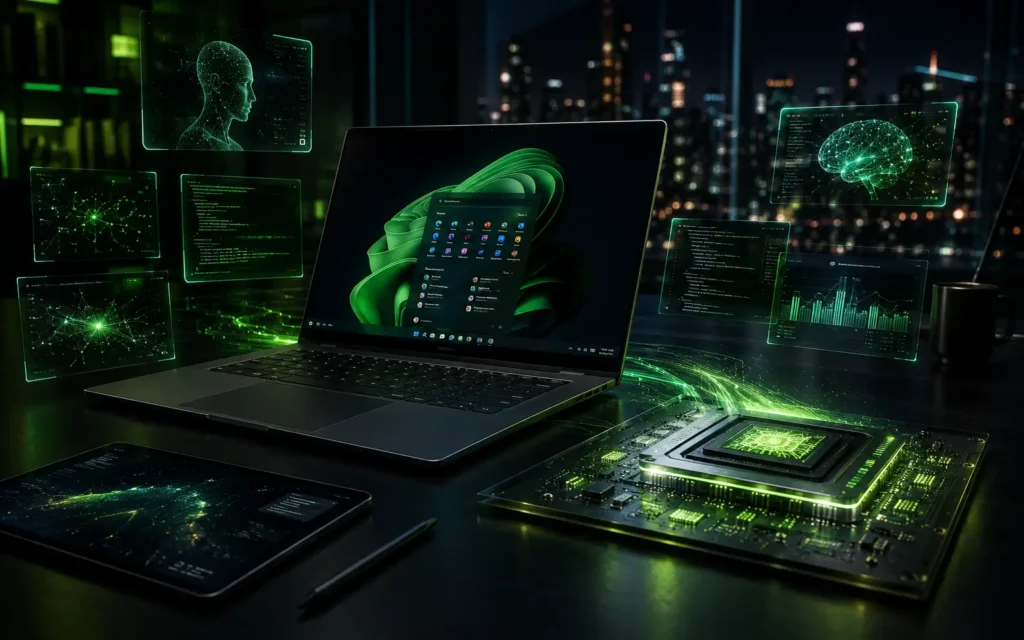
Every other graphics card, for the last few decades, has been the king for users of gaming PC. For several decades, NVIDIA has been the undisputed king of discrete chips. For enhanced gameplay, you’d buy an NVIDIA graphics card and use an Intel or AMD processor for work involving AI, you’d buy an NVIDIA graphics card and use either an AMD or Intel processor. That split is now a thing of the past. The NVIDIA RTX Spark is a single chip with both CPU and GPU – the first-ever processor built for Windows laptops and desktop PCs.
The chip was initially rumored under the code name of ‘N1X‘ for more than a year and officially announced on May 31, 2026, at Computex Taipei and GTC Taipei. It was designed in partnership with MediaTek, a company with extensive experience designing ARM-based SoCs, and brings to the table the power efficiency and connectivity facets of the chip. This marks the creation of a chip NVIDIA calls a “superchip” for the first time, and this time, it really does sound like an understatement.
Why This Is a Big Deal for Windows Users
Since 2020, the world of tablet and laptop PCs has been forever changed by Apple Silicon for users of Windows operating systems. All of that in one integrated chip suddenly made MacBook have incredible battery life, thin designs, and serious performance. Qualcomm’s subsidiary was able to present a comparable product, but each has its own drawbacks, with Qualcomm’s Snapdragon X Elite being an upwardly mobile device that failed to provide Apple’s level of AI and GPU performance on Windows laptops.
RTX Spark is able to shift all that. NVIDIA is far from being just another player trying to insert itself into the chip market; it’s the company that already commands global supremacy in AI computing infrastructure. NVIDIA powers all of the large AI data centers. All the same skills now transfer to your laptop. On the stage, Jensen Huang summed it up: “In 40 years, you have developed apps, click type RTX Spark + Microsoft Windows, and you ask the computer for answers.
NVIDIA RTX Spark Full Specs
Here is the complete technical specification breakdown for the RTX Spark superchip:
| Specification | Details |
|---|---|
| CPU | 20-core NVIDIA Grace (ARM-based), co-designed with MediaTek |
| GPU | Blackwell RTX with 6,144 CUDA Cores + 5th-Gen Tensor Cores |
| NPU | Dedicated Neural Processing Unit for AI acceleration |
| Memory | Up to 128GB LPDDR5X Unified (CPU + GPU shared) |
| Memory Bandwidth | 300 GB/s |
| Interconnect | NVIDIA NVLink-C2C chip-to-chip |
| AI Performance | 1 Petaflop (FP4 precision) |
| Process Node | TSMC 3nm |
| Max Local LLM | 120B parameters with 1 million token context |
| Gaming | AAA titles at 1440p, 100+ FPS with Ray Tracing + DLSS 4.5 |
| Video Editing | 12K 4:2:2 via Blackwell hardware decoder |
| 3D Rendering | 90GB+ scenes via OptiX + DLSS |
| Laptop Thickness | As thin as 14mm |
| Laptop Weight | Starting from 3 lbs (approx. 1.36 kg) |
| Availability | Fall 2026 |
CPU — NVIDIA Grace, Co-Designed with MediaTek
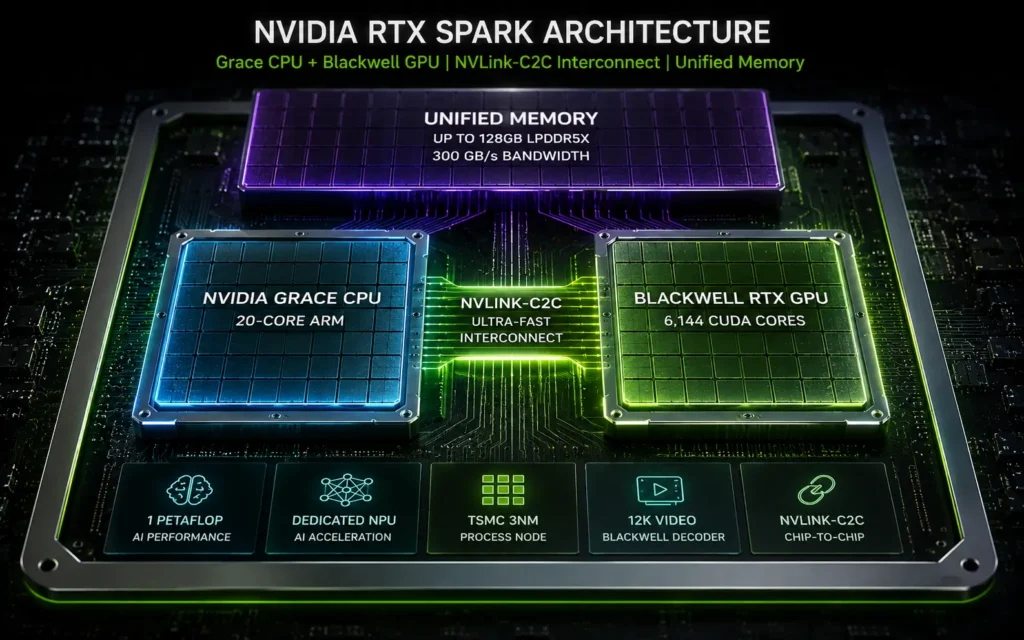
The RTX Spark CPU should be powered by NVIDIA’s new 20-core Arm-based chip, called NVIDIA Grace, in collaboration with MediaTek. The base count, which is the same as the i7 processor has, is pretty heavy going even for a desktop processor, and much heavier than that for a laptop processor. These sustained, multi-threaded tasks are what AI agents require: the Grace CPU is designed to meet these needs, with tasks that won’t throttle even when performed at the same time.
The CPU ties into the GPU, with a proprietary high-bandwidth NVLink-C2C link between the two that can transfer data at rates that the standard Pie lanes can’t compete with. The same interconnect NVIDIA employs in its data center systems has been scaled down to fit in a laptop.
GPU — Blackwell Architecture, RTX 5070-Class Performance
RTX Spark’s GPU uses NVIDIA Blackwell architecture, the same as used by the RTX 5090 and RTX 5080 desktop cards. It initially has 6144 CUDA cores and fifth-generation Tensor Cores with FP4 precision. NVIDIA claims the NVIDIA Max-Q GPUs have essentially the same performance as one of the more powerful mid-range desktop cards available today, the RTX 5070.
Most importantly, it’s NOT a “water turned down” laptop GPU. It includes the complete RTX software suite, including extensive CUDA support (even NVIDIA’s competitors don’t include this), RTX ray tracing, DLSS 4.5 and Frame Generation, NVIDIA Reflex, G-SYNC and OptiX for rendering. More than a thousand existing Windows apps and games already work with this stack – that means RTX Spark laptops don’t need any support to begin the day because there is support for them from day one.
Memory — 128GB Unified and Why It Matters
Available up to 128GB of LPDDR5X unified memory at up to 300 GB/s bandwidth may be one of the most major and useful specs on this chipset. Unified Memory is a solution in which data is stored in the memory shared by both CPU and GPU, nd no data is copied between them on separate memory buses. First introduced to the masses by Apple Silicon, RTX Spark extends the idea by providing more memory and bandwidth to the equation.
In reality, such an AI model with 120 billion parameters would need about 60- 80 GB of memory to load it. No competitor chip at this size can accommodate this. Snapdragon X Elite doesn’t include storage that exceeds 64GB. Apple M5 Pro tops at 64GB, M5 Max at 128GB. In terms of capacity, RTX Spark’s 128GB tops out at the same level as the M5 Max—and with much greater AI compute power under the hood.
What Can NVIDIA RTX Spark Actually Do?
Run 120B AI Models Locally — Without the Cloud
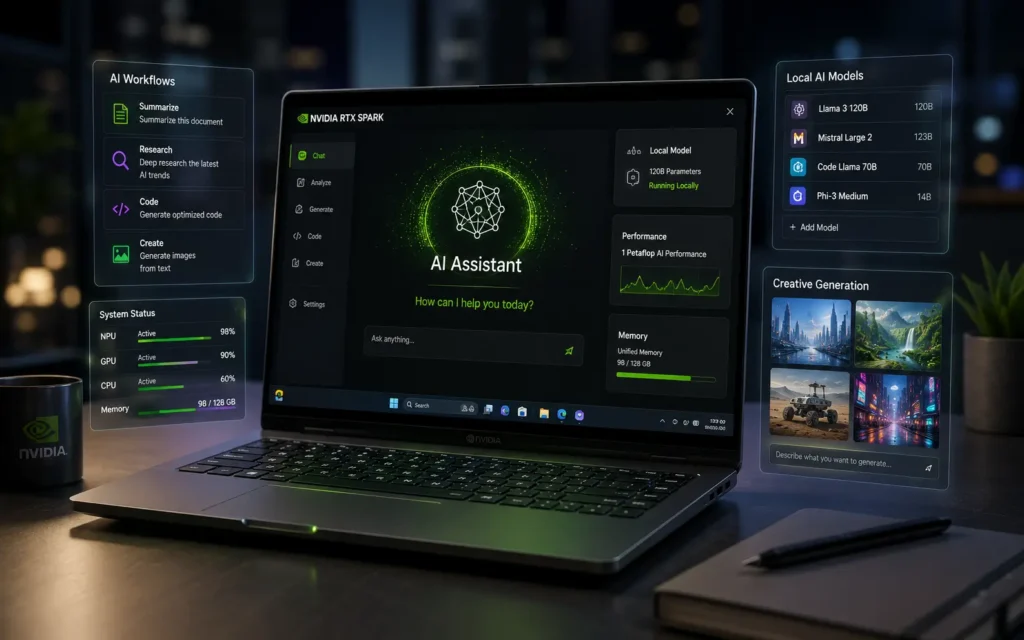
The big thing about RTX Spark is that it isn’t just about producing 120 billion-parameter LLMs on-device, but it’s about all the LLMs. It is the use of the 120-billion-parameter LLMs that is the headline feature of RTX Spark, not just any 120-billion-parameter LLMs, but all the LLMs. For reference, GPT-4 is thought to contain approximately 1.8 trillion parameters, while open-source models with 70B and 120B parameters are already pretty good at handling most things in the real world. You do not have to break any ethics by moving your data out of your machine to run these models, and you do not pay per API call, as you don’t have to do anything outside your machine.
This isn’t theoretical. At GTC Taipei, NVIDIA showed the running of Llama class models locally on RTX Spark. At GTC Taipei, NVIDIA demonstrated how to run locally on RTX Spark using Llama class models. The fact that it supports a 1 million token context window allows you to load gigabytes of code, entire books, or months of emails under one prompt and get coherent answers. It has the potential to get you a lot more for your money than a cloud-based alternative.
NVIDIA OpenShell — Secure AI Agents on Windows
A new challenge is added when the AI should be executed on-site: security. To fix this, NVIDIA and Microsoft have partnered up on NVIDIA OpenShell. OpenShell is a runtime used between AI agents and your Windows system, which specifies what each agent can do: which files to access, which apps to control, and what it cannot touch.
Any queries that do go to the cloud are automatically “bled” and ” muted” by OpenShell before leaving your device, so that any data classified as “personal” is stored in an encrypted format. Any requests sent outside of the device are “bled” and “muted by OpenShell, meaning any personal data is stored in an encrypted format. Leading agentic AI platforms like OpenClaw and Hermes Agent (formerly from Nous Research) have already promised to create natively built applications for Windows that will utilize RTX Spark and OpenShell. For RTX Spark devices, Microsoft is embedding this functionality right into the Windows taskbar. For RTX Spark devices, Microsoft will include the ability to use its agents in the taskbar.
Gaming — AAA Performance in a 14mm Laptop
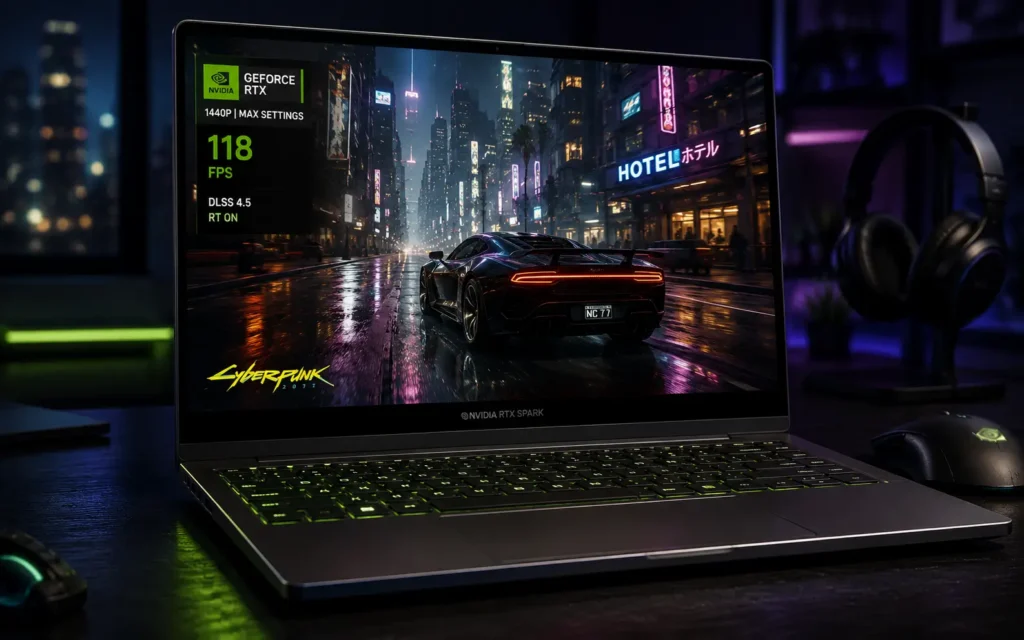
RTX Spark is no afterthought; it’s a serious gaming platform. With DLSS 4.5 Frame Generation, NVIDIA claims support for over 100 frames per second (fps) of fluid quality at AAA games at 1440p resolution. Cyberpunk 2077, DOOM: The Dark Ages, NARAKA: BLADEPOINT, Remedy Entertainment, Riot Games, and XBOX are just some of the confirmed titles that will run well on RTX Spark.
There are two things here that strike me. First, the performance is constant whether the computer is plugged in or on battery, which is a problem common to gaming laptops for many years. Secondly, the DLSS 4.5 Ray Reconstruction is a new 2nd generation transformer model that has enhanced visual quality over prior transformer models with similar performance impact. It’s arriving for Blender 5.3 and dozens of games later this August 2026.
Creative Workflows — Adobe, Blender, and 12K Video
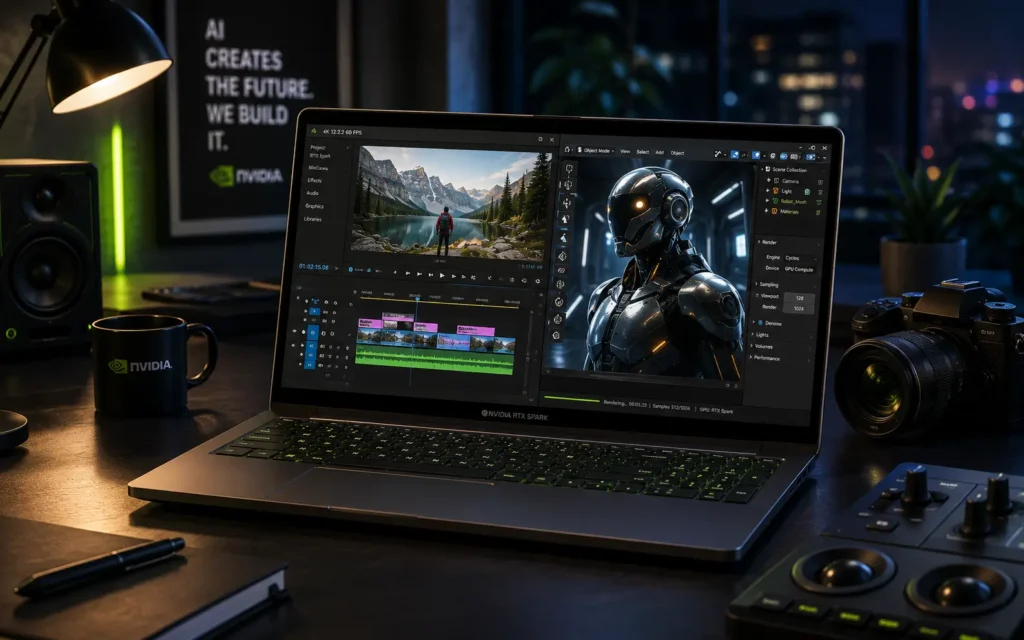
RTX Spark is paying homage to content creators. The chip supports 12K video editing using the dedicated Blackwell hardware decoder, delivers 3D post-production up to 3 times faster than ever before with OptiX and DLSS, and boosts 4x the speed of complex video generation with ComfyUI AI with the dedicated 4x Frame Generation.
This is the most important news regarding the Adobe Catastrophe. This is not only an example of Adobe optimizing its apps for RTX Spark, but it is also an example of reinventing both Photoshop and Premiere from the ground up for the chip. Thereby, AI and graphics performance will be improved up to 2x within both applications. The native RTX Spark pipelines are being implemented in various tools in Adobe Photoshop, Adobe Premiere, Substance 3D Painter, and Substance 3D Stager. Other partners include Blackmagic Design, Blender, CapCut, ComfyUI and OTOY.
Compact Desktop PCs — Not Just Laptops
RTX Spark is not only coming to laptops. NVIDIA has announced a series of small, yet powerful, and highly energy-efficient desktop PCs running on the same chip designed for AI workloads, creative tasks, games, and productivity. NVIDIA estimates that approximately 10 laptop designs will come out in Fall 2026, and 30+ laptop models will be available as well.
NVIDIA is also rolling out NVIDIA DGX Station for Windows, a deskside Blackwell AI supercomputer that can be deployed fully with developer-focused advanced AI agents and models to accelerate cutting-edge AI research, development, and deployment on local premises.
RTX Spark Laptops — All Confirmed Models
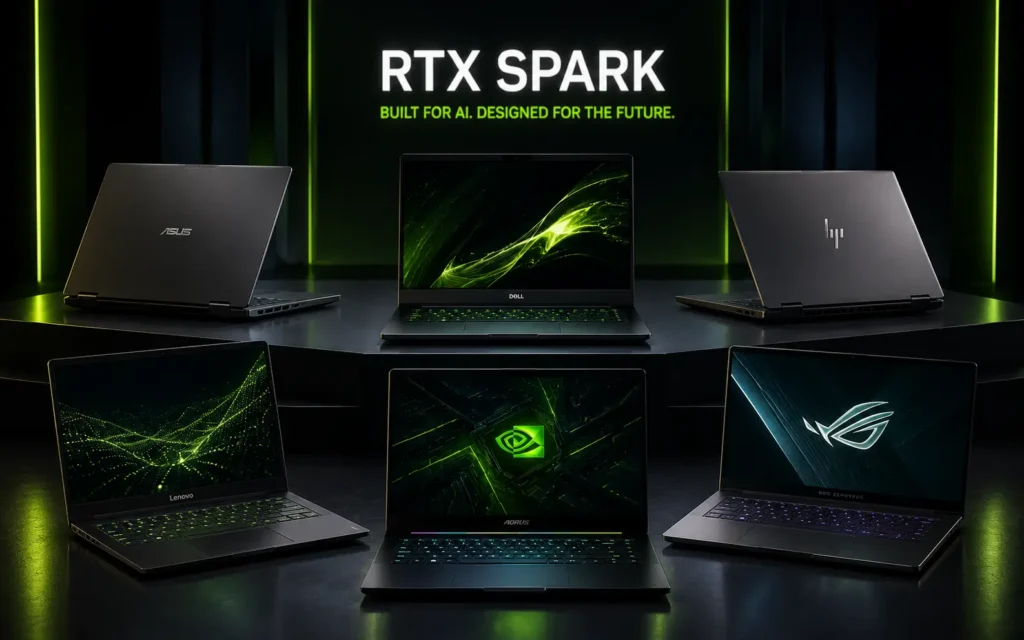
NVIDIA has announced that more than 30 laptops and approximately 10 compact desktops will be shipping during Fall 2026. Here is a list of all the devices confirmed thus far:
| Brand | Model | Form Factor | Focus |
|---|---|---|---|
| Dell | XPS 16 Creator Edition | 16-inch Laptop | Creative professionals |
| HP | OmniBook X14 | 14-inch Laptop | Thin, portable, agentic AI |
| HP | OmniBook Ultra 16 | 16-inch Laptop | Power users and developers |
| Microsoft | Surface Laptop Ultra | Laptop | Windows agent experience |
| ASUS | ProArt P14 | 14-inch Laptop | Creators and designers |
| ASUS | ProArt P16 | 16-inch Laptop | Professional workstations |
| Lenovo | Yoga Pro 9N | 16-inch Laptop | AI-first slim design |
| MSI | Prestige N16 Flip AI | 16-inch 2-in-1 | Versatile creator device |
| Acer | TBA | TBA | To follow after launch |
| GIGABYTE | TBA | TBA | To follow after launch |
Dell XPS 16 Creator Edition
Dell’s XPS 16 Creator Edition is the company’s flagship RTX Spark product that targets creative professionals. Michael Dell personally endorsed the launch: creators can’t be expected to agree to sacrifice portability and slimness for performance. The XPS 16 is optimized to be all — thin chassis, OLED display and full RTX Spark performance.
HP OmniBook X14 and Ultra 16
The two new notebooks, the HP OmniBook X14 and Ultra 16, are among the thinnest RTX Spark designs in the full product range, HP claims. The company is aiming for agentic developers and power users who demand the entire NVIDIA software suite in a plug-and-play format with all-day battery power. These devices were clearly identified as the ones designed for an agentic AI age by HP’s interim CEO.
Microsoft Surface Laptop Ultra
The Microsoft Surface Laptop Ultra is definitely one of the most crucial devices in the RTX Spark lineup. The Windows security primitives and NVIDIA OpenShell were co-developed by Microsoft and NVIDIA, so there are definitely some enhancements and refinements to see on the Surface hardware. For the ultimate RTX Spark software experience at launch, Surface Laptop Ultra is the laptop you should keep an eye on.
ASUS ProArt, Lenovo Yoga Pro 9N, and MSI Prestige
ASUS has designed the P14 and P16 to give its users a higher level of precision, such as those who use iMovie, Photoshop, Blender, or Substance 3D. Lenovo’s Yoga Pro 9N is a design that features AI-first elements and a slender chassis design. The Multiple Sclerosis Institute Prestige N16 Flip AI also includes 2-in-1 functionality, which is convenient for those who want a tablet-style interface to enjoy digital drawing or a presentation.
NVIDIA RTX Spark vs Apple M5 vs Snapdragon X Elite
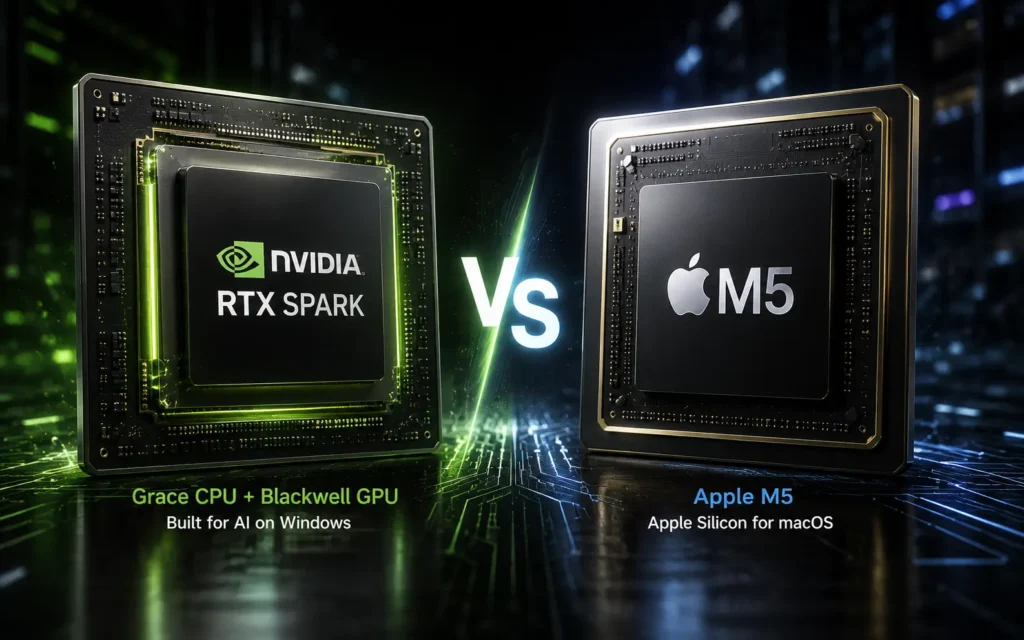
RTX Spark is entering a market with two established competitors. Here is how it stacks up on paper:
| Feature | NVIDIA RTX Spark | Apple M5 Max | Snapdragon X Elite |
|---|---|---|---|
| Architecture | ARM (Grace + Blackwell) | Apple Silicon (ARM) | ARM (Oryon CPU) |
| CPU Cores | 20 (NVIDIA Grace) | 16 (4P + 12E) | 12 (Oryon) |
| GPU Cores | 6,144 CUDA Cores | Up to a 40-core GPU | Adreno X1 Elite |
| Max Unified RAM | 128GB LPDDR5X | 128GB LPDDR5X | 64GB LPDDR5X |
| AI Performance | 1 Petaflop (1,000 TOPS) | ~38 TOPS | ~45 TOPS |
| CUDA Support | Yes — Full Stack | No | No |
| Ray Tracing | Yes — Full RTX | Basic support | Basic support |
| DLSS / Frame Gen | Yes — DLSS 4.5 | No | No |
| Local LLM (Max) | 120B parameters | ~70B parameters | ~13B parameters |
| Gaming (Windows) | AAA 1440p 100+ FPS | Limited (macOS only) | 1080p moderate |
| OS Platform | Windows | macOS | Windows |
| Process Node | TSMC 3nm | TSMC 3nm | TSMC 4nm |
| Available Now | Fall 2026 | Yes | Yes |
AI Performance — RTX Spark Is in a Different League
RTX Spark provides 1 Petaflop – 1,000 TOPS of AI performance. The Apple M5 is around 38 TOPS. In Snapdragon X Elite, it is estimated to perform approximately 45 Tera Operations Per Second (TOPS). That’s a significant difference: RTX Spark is approximately 20 to 25 times more powerful when it comes to pure AI compute. This is not a hypothetical, either. It directly affects your ability to run AI models locally, the speed of their response time, and the size of the window you can use as context. For 120B parameter models, RTX Spark can be used. The highest price of Snapdragon X Elite is approximately 13B. Apple M5 Max is capable of delivering around 70B in a single time.
Gaming — CUDA and DLSS Change Everything on Windows
They’re a big advantage over their competitors in terms of gaming on Windows. Even with the existing library of NVIDIA-optimized creations and games, they will be available straight out of the box, a capability that Apple Silicon or Snapdragon can’t boast. The DLSS 4.5 Frame Generation can help double and triple your performance in the supported games. Apple M5 gaming: A way it got better, but still stuck with the macOS game library. Snapdragon X Elite has improved its Windows game statistics, but it simply isn’t up to the level for comparison with Blackwell.
The Honest Weakness — You Cannot Buy It Yet
The big negative of RTX Spark is the timing. It is the only time that Apple M5 products will be on sale. The Snapdragon X Elite laptops hit the market on July 4th. However, RTX Spark notebooks will not be available until Fall 2026, and benchmarking results that prove NVIDIA’s performance claims are not yet available. Slightly smaller numbers may have appeared in the real world due to pre-launch demonstration data and what may actually be in place.
Nevertheless, NVIDIA did have real, working prototype laptops on display at Computex, from Dell, ASUS, MSI, and more. It is no vapourware: hardware is available, nd partners are waiting. If NVIDIA hits just 80% of the sweet promises – as they could certainly do – then RTX Spark will be the best Windows laptop GPU on the market.
RTX Spark Release Date and Expected Price
When Can You Buy an RTX Spark Laptop?
ASUS, Dell, HP, Lenovo, Microsoft Surface, and MSI are introducing their new RTX Spark laptops and small desktops for Fall 2026. Acer and GIGABYTE will soon be followed by their own models. NVIDIA has stated that it won’t provide a precise release date, so stay tuned for any specific announcements at both the upcoming Microsoft Build (June 2-3, 2026) and at future events closer to the fall release.
How Much Will RTX Spark Laptops Cost?
No official prices have been released yet. If you are looking for the flagship RTX Spark laptop, look forward for a price range of $2,000 – $3,500 on a purchase basis, considering the hardware specifications, premium model lineup, and location of the chip on Apple M5 Max laptops. The lower-line specs with less memory (as little as 16GB) might be cheaper than the high-end machines, but perhaps not quite as early.
If you use the prices for the Apple MacBook Pro with M5 Max to compare, that will cost you $2,499 for starters. The price of a high-end Snapdragon 8 X laptop such as the Surface Laptop 7 begins at $1299. RTX Spark’s architecture is expected to offer more performance than its Snapdragon X Elite, commanding similar or higher costs. The RTX Spark will be on par with or slightly above the Snapdragon X Elite price tags and will be competition for M5 Max MacBook Pros in terms of performance.
Why ARM Architecture Matters for Windows Laptops
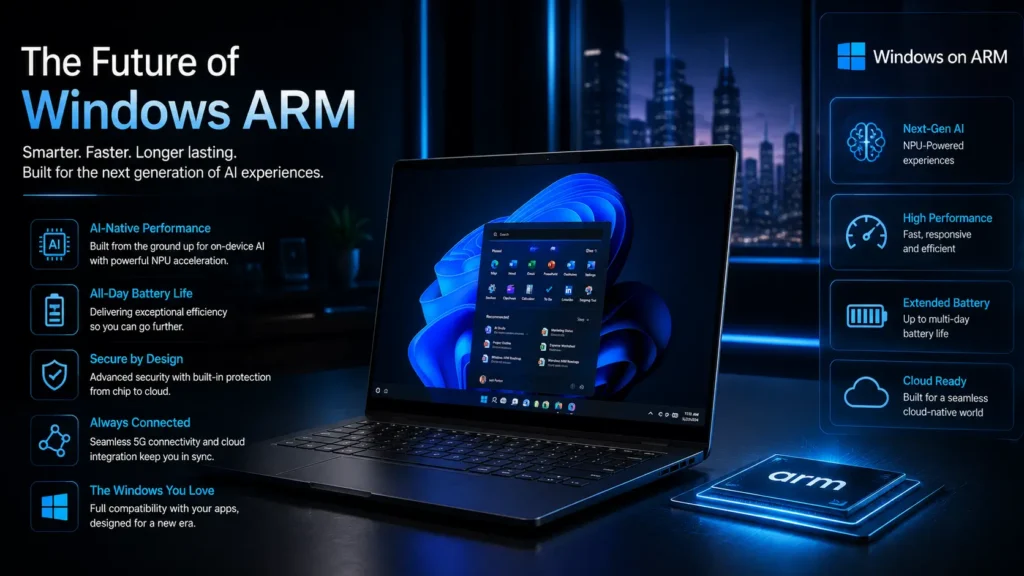
The End of x86 Dominance?
For 40 years, PCs running Windows have been based on x86 processors from Intel and AMD. By default, if the architecture for tablets, phones, and now RTX Spark was dubbed to be lower dissipation methods of consumption, the ARM version was believed to be the best. This perception has totally changed. ARM chips also beat x86 in terms of power efficiency, and now are beginning to compete with it in raw processing power.
The benefit is at the architecture level: ARM chips can use more of their transistors to compute versus the backward-compatible logic that x86 must implement. That’s why Apple Silicon MacBooks can play for 20+ hours on a charge without compromising on performance. With NVIDIA’s world-class expertise in GPUs, RTX Spark will provide the same efficiency that Linux has to Windows.
Windows on ARM Is Ready Now
One year ago, a concern worthy of attention with laptops running Windows on ARM processors was software compatibility. There were several apps that weren’t run natively, which negatively impacted performance. This condition has greatly improved, however. Microsoft has been working diligently on the native ARM versions of its applications, and major developers have already provided native ARM versions of their applications. Also on par with companies that already support the entire CUDA stack natively is RTX Spark. It’s also great news that the entire CUDA stack will be supported natively with RTX Spark.
Final Thoughts
NVIDIA RTX Spark isn’t simply yet another chip announcement. It’s NVIDIA the enterprise that enables what AI performance looks like at the data center level, putting that power right into your laptop. The specs are pretty astounding: 1 Petaflop of AI compute for a god-level advantage in field use, a Blackwell RTX GPU, 128GB of unified memory, and a chassis that is as thin as the best of the ultrabooks available.
Carefully watch the competition. Emily Jefferson is a Windows-native contender for Apple Silicon, which is as ambitious and hardware-focused as it gets. Qualcomm, which had the lead in the Windows on ARM discussion a year ago, now has competition with a far more robust GPU and AI software ecosystem. But truth will be revealed in Fall 2026. RTX Spark will arguably be the most interesting feature of a Windows laptop to come along in years, however, if NVIDIA actually does deliver what it demonstrated at Computex. If it’s possible to wait until the fall, and if it’s possible for those of us in this position, it might be worthwhile to wait and see how things come out in the fall, and whether it will work out for you or not.
Read More : Multipoint Control Unit (MCU) | Why It Still Matters The Complete Guide for 2026
Frequently Asked Questions
What is NVIDIA RTX Spark?
NVIDIA RTX Spark is the first-for-all NVIDIA superchip to run on a Windows PC. It features a 20-core ARM-based Grace CPU and an 8GB Blackwell RTX GPU with 6,144 CUDA cores that are housed in a single TSMC 3nm chip and, at most, 128GB unified memory. The announcement of the same has been made at Computex 2026, and it is debuting in Fall 2026.
Is NVIDIA RTX Spark better than Apple M5?
On AI performance, RTX Spark is miles ahead, having 1 Petaflop per second of computational power vs Apple M5’s 38 TOPS.RTX Spark, however, is many times faster on AI, with 1 Petaflop per second compared to Apple M5’s 38 TOPS; bigger AI models can be run locally. In the Windows console gaming arena, RTX Spark clearly edges the competition with CUDA and DLSS 4.5. Though the Apple M5 is currently available, it still has an established macOS ecosystem, which isn’t a bad thing for Mac users.
Which laptops will have NVIDIA RTX Spark?
These include the XPS 16 Creator Edition from Dell, OmniBook X14 and Ultra from HP, Surface Laptop Ultra from Microsoft, Yoga Pro 9N from Lenovo, and the ASUS ProArt P14 and P16, and the newly announced Lenovo Yoga N16 Flip and MSI Prestige N16 Flip AI. More than 30 different laptop models are projected to be available through Fall 2026; the compact designs of desktop models run around 10.
Can NVIDIA RTX Spark run AI models without internet?
Yes. RTX Spark comes ready to run 120 billion parameter large language models on-device and without the need for any cloud connection, with up to 1 million tokens per context. It takes advantage of up to 128GB of unified memory and 1 Petaflop AI performance, the latter of which no other laptop chip can match.
What is NVIDIA OpenShell?
NVIDIA OpenShell is the NVIDIA security runtime co-developed with Microsoft, which comes with RTX Spark. It restricts what on-device ones can access and does on your PC, and it ensures that personal data isn’t exposed in cloud queries, and it also gives a layer of security and support on which the whole Windows-native user experience of the said on-device AI agents is built.
When is the NVIDIA RTX Spark release date and price?
The second-generation RTX Spark laptops will be released in Fall 2026. An exact date as well as official pricing has yet to be given. Positioning and specs dictate flagships to be sold in the $2,000 to $3,500 range, with lower-priced versions potentially taking a shot at the lower end of the $2,000 mark.