Apple has been eyeing the foldable smartphone market in the background for years. Samsung, Google, and Motorola likewise went through various generations of foldable gadgets. Yet, Apple remained quiet, for only now, along with half, they were watching to not disclose something they saw as an issue. That patience is soon coming to an end in 2026. What is now called the iPhone Fold might look like an iPhone Ultra and is likely one of the biggest hardware introductions in Apple’s history.
This is the latest info known about Apple’s first-ever foldable case: design philosophy, complete specifications, software experience, pricing, and details about when consumers will be able to purchase one.
Why Apple Waited So Long to Build a Foldable iPhone
People have not asked themselves what the iPhone Fold looks like because it most importantly is not ‘available,’ and they have instead asked themselves why Apple waited so long to create the iPhone Fold. Two deal-breakers Apple cited in reviewing initial foldable smartphones were the crease visible through the inner screen of the smartphone, and also the durability of the screen hinges when repeatedly bent and flexed over the years.
The first Galaxy Z Fold was introduced in 2019 by Samsung. The crease was distracting, and there were reports of failed hinges within months of that. Those failure points were studied by Apple, but they found that they couldn’t accept putting the same compromises of the market in their product. According to Bloomberg’s Mark Gurman, the foldable that’s coming up next is the culmination of a years-long internal effort by Apple that concentrated on getting rid of the fold and developing a “hinge” that’s tough enough to withstand Apple’s durability standards.
There’s a business logic to it, too. Excessively small market for the early foldable smartphone is no thing for Apple to bother with. However, by 2026, Samsung found that there was a significant demand for high-end book-shaped foldables, while the industry for high-quality foldable OLEDs had also developed. Apple doesn’t usually pioneer a category; it steps in when it thinks it’s able to make its own rules there.
The Design: A Passport in Your Pocket
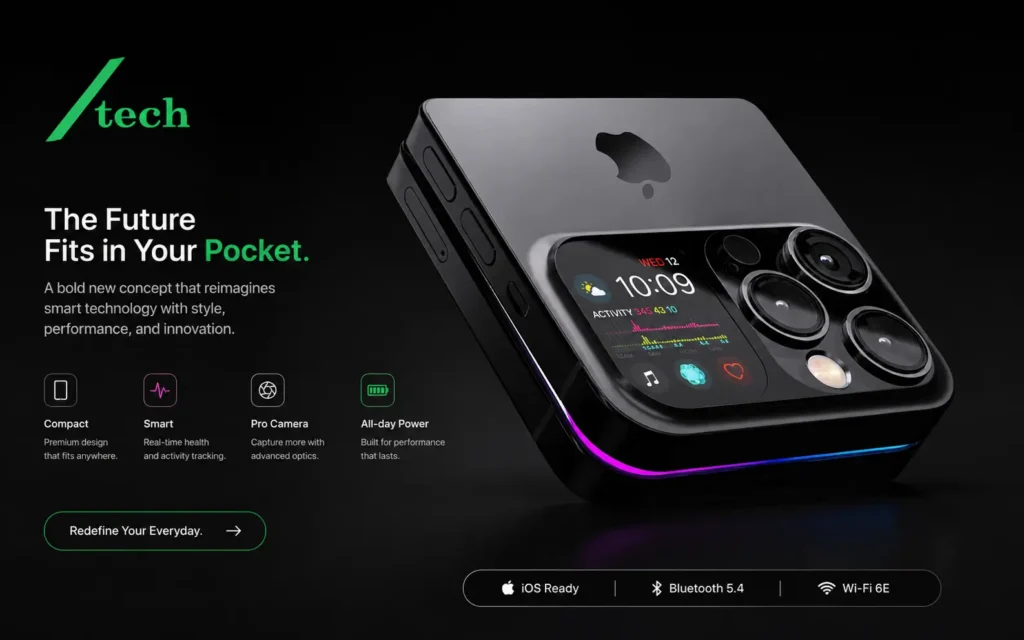
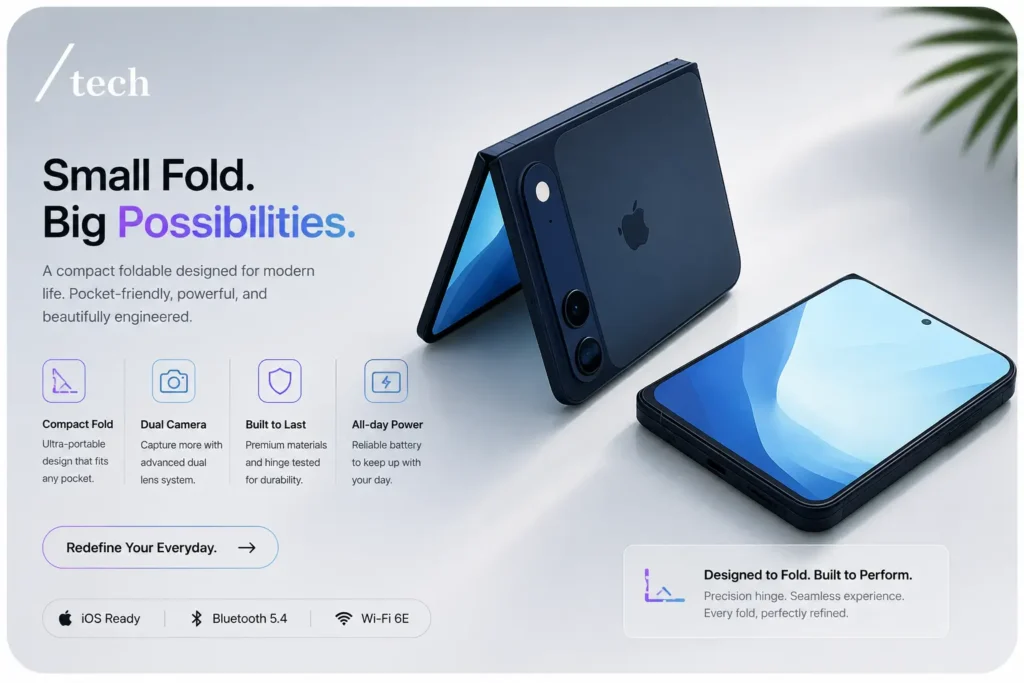
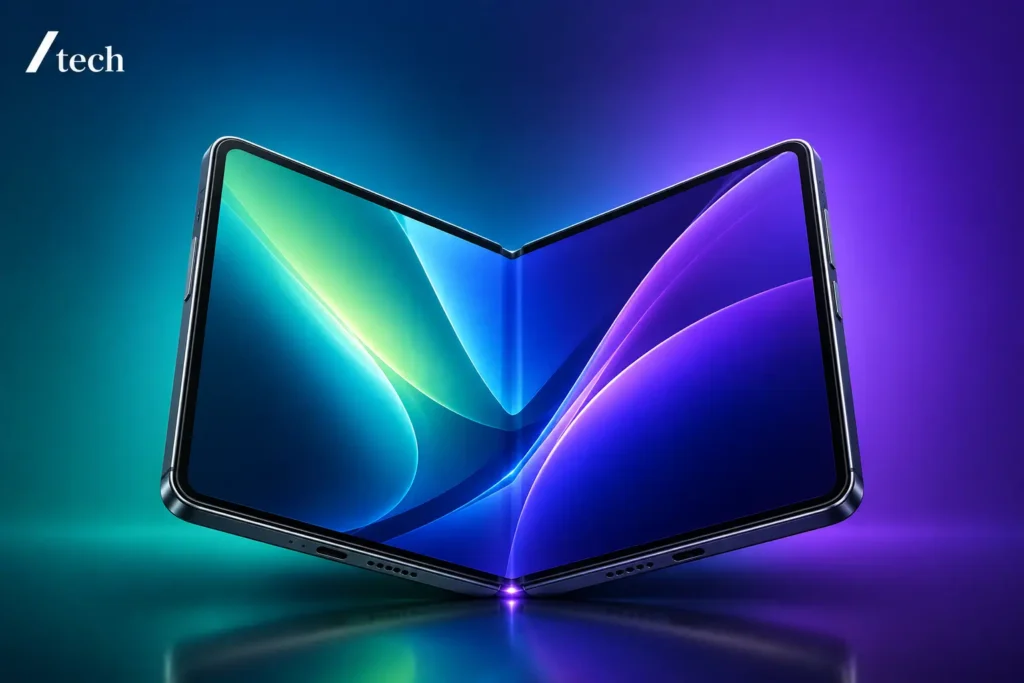
The iPhone Fold design deviates from all the previous iPhones form. This device differs from a tall and narrow slab, but it is a wide device when closed. A bit like an iPhone in the passport style, but squatter and smaller when folded compared to a standard iPhone, which is what it’s called in leaked CAD drawings and in a physical DUMMY unit, shared by the leaker Sonny Dickson.
The device, when opened up, unfolds like a book with a large inner display more akin to a smaller iPad Mini than a phone display. This outer cover display can be fully used as a screen to view notifications, quick replies, and camera communication when closed.
Build Materials and Hinge Engineering
Apple is employing two metals: Titanium and Aluminum for the chassis. The hinge is expected to feature a Liquid metal alloy, a proprietary product that is lighter and more highly resistant to deformation than such materials as titanium and stainless steel that competitors are using. The crease problem is solved by using an advanced optically clear adhesive that evenly distributes fold stress in the panel, and a new transparent polyimide film on the display surface with higher surface hardness than that of the PET film most competitors use, which reduces the risk in the future.
Thickness, Weight, and Button Layout
When unfolded, the iPhone Fold is said to be 4.5mm thick, making it Apple’s thinnest phone ever, even thinner than the 5.1mm iPad Pro. The folded standard size is 9mm and 9.5mm, nd it has a weight of about 255 grams. The volume controls are moved to the top edge to make way for the Liquid metal hinge and the bigger battery. For easy shooting, a dedicated button on the camera’s control dial is also included.
Display: Two OLED Screens, One Crease-Free Experience
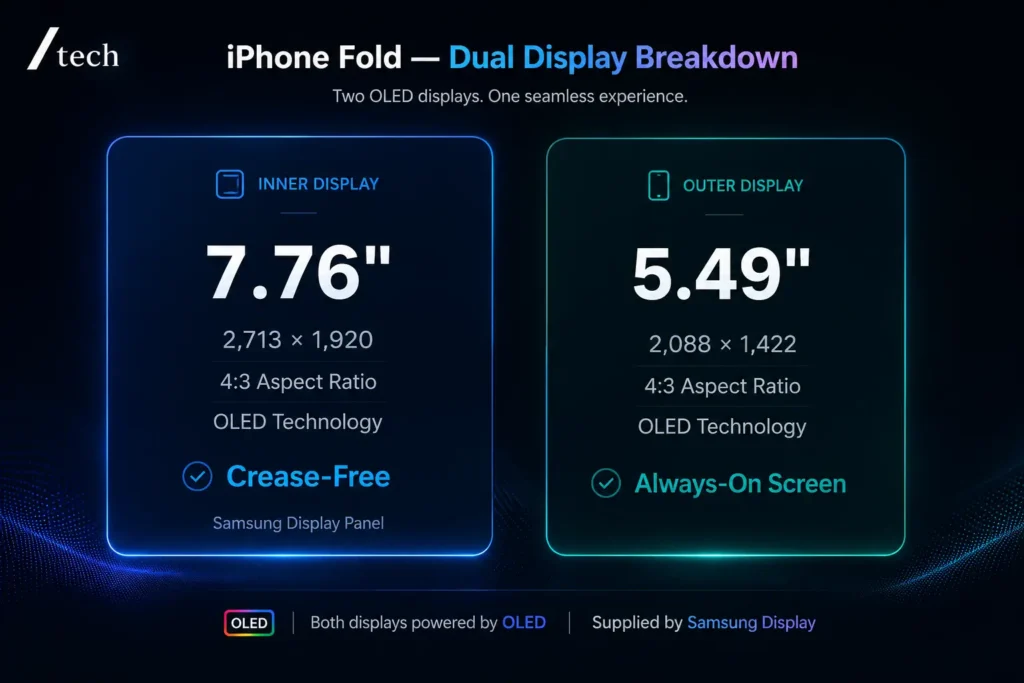
The inner display is 7.76 x 7.8 inches and has a 2,713-by-1,920-pixel resolution and 4:3 aspect ratio (the same ratio as the iPad). This translates to a bigger tablet-sized canvas when opened quite different from Samsung’s tall and slender inner displays.
The outer display measures 5.49 inches at 2,088 by 1,422 pixels, also 4:3. Amidst these, both are based on OLED foldable display technology provided by Samsung Display. Samsung debuted a crease-free panel at CES 2026 with its laser-cut metal support structure, which absorbs flex strains during folding, according to several reports from Bloomberg and others, and that’s what Apple appears to be doing as well.
| Display | Size | Resolution | Aspect Ratio | Technology |
|---|---|---|---|---|
| Inner (unfolded) | 7.76–7.8 inches | 2,713 × 1,920 | 4:3 | OLED |
| Outer (folded) | 5.49 inches | 2,088 × 1,422 | 4:3 | OLED |
Performance: A20 Pro Chip and 12GB RAM
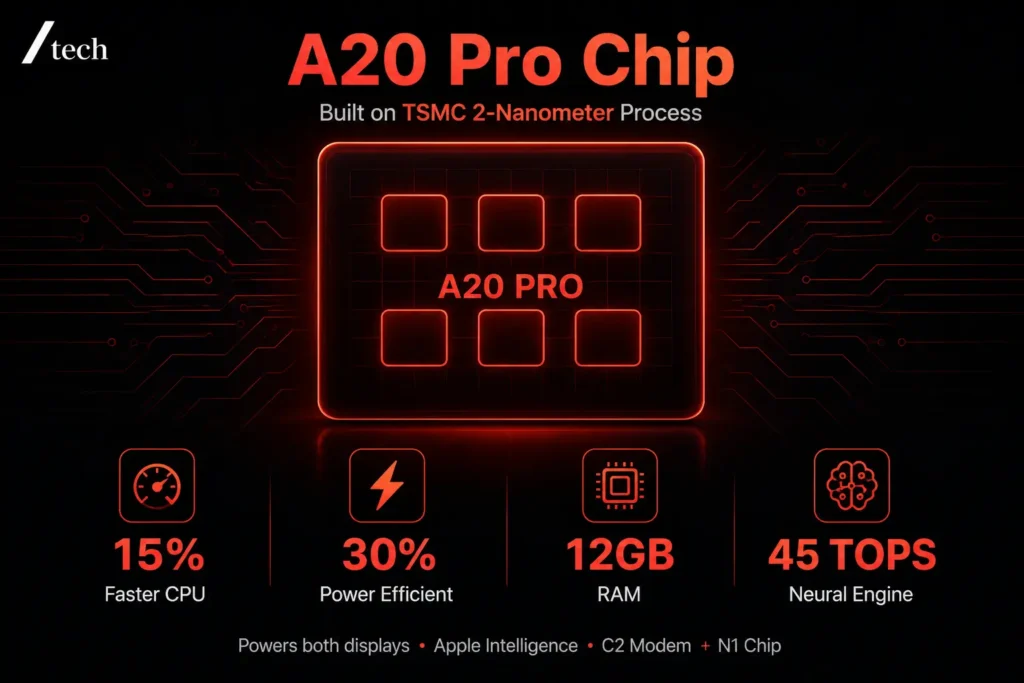
The iPhone Fold is powered by Apple’s A20 Pro chip, which also powers the iPhone 18 Pro, and is produced using TSMC’s 2nm manufacturing process. In the iPhone 17 Pro lineup, Analyst Jeff Pu claims the A20 Pro has 15 percent faster CPU performance and 30 percent improved power efficiency as compared to its counterpart, the A19 Pro. The efficiency is essential to bring two high-resolution OLED displays online simultaneously.
The 12GB of RAM allows for the seamless integration of advanced multitasking and processing capabilities with Apple Intelligence on the device. The connectivity is based on Apple’s C2 modem and N1 chip for Wi-Fi 7 and Bluetooth, which are featured in Apple’s entire 2026 lineup.
Camera System: Dual 48MP with Selfie Advantage
Not going to 3.5mm meant settling for a dual camera at the rear, rather than a triple-lens camera. The two 48-megapixel dual-cameras (main wide and ultrawide chimera) mount on top of a camera base set mounted on a deep-black color camera base, irrespective of the general color of the device, resulting in a high-contrast appearance akin to using a professional camera setup.
The front camera is equipped with two of them – one on the outer part of the display when closed and one near the inner display when opened for video purposes. The outer camera can additionally be utilized as a viewfinder for the rear lenses to take 48MP selfies with the main camera – an actual benefit over typical iPhones. No Face ID, Touch ID is on the button instead; Apple couldn’t fit the Face ID tech into such a thin device.
Battery: The Largest Ever in an iPhone
Apple moved the volume buttons and retained the logic board on one side of the device to free up room for the dual-cell battery, which could be anywhere from 5,000mAh to 5,800mAh. Both are wireless charging and MagSafe compatibility, both of which have already been seen in the existing iPhone lineup. This will be seen as true in terms of best-in-class battery life, given that the disposition is not just from the 7.76-inch inner screen, but also from the outer screen, A20 Pro, and Wi-Fi 7 as well. The expectation is not the very special battery life of a breakthrough with such complexity; it’s merely competitive.
Software: iOS 27 Built for the Fold
The iPhone Fold is running iOS 27 not iPadOS. Will NOT offer Stage Manager or iPad-style multi-tasking in Windows. Mark Gurman has likened iOS 27 to a “Snow Leopard” release, with an emphasis on performance and architectural depth rather than on the flashiest of elements. The naming says it all: that’s why iOS 27 is being constructed in part to provide the iPhone Fold with a strong, effective base. Features to take note of are:
- Active app split-screen multitasking run two apps side by side on the inner display.
- Optimized Native Apps: Mail, Messages, Safari, and Notes have reworked their layouts on the 4:3 canvas and have included a sidebar option.
- into the inner screen.Smooth display transitions when opening — the active app expands to the inner screen; closing — the active app collapses back to the inner screen.
Developers are given tools to help them optimize apps for use on the broader aspect ratio. IOS 27 will have to start building an optimized ecosystem for foldables from scratch, and this will take some time before the app ecosystem fully meets up with these devices.
Pricing: Starting at $1,999
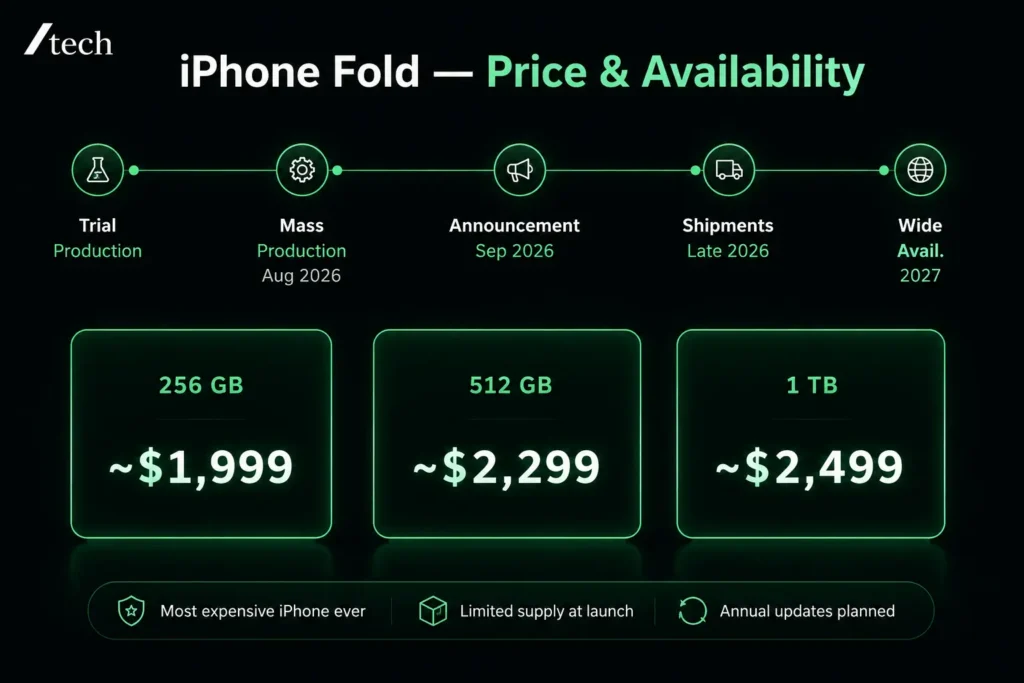
All reliable sources estimate the iPhone Fold base price to be above $2,000, and most are going by $1,999 for the lowest-specification variant: the 256GB storage. This seems to be a new product category: a high-demand flagship phone that’ll take the place of both the phone and the tablet for the right individual.
| Storage | Estimated Price | Positioning |
|---|---|---|
| 256 GB | ~$1,999 | Entry-level configuration |
| 512 GB | ~$2,299 | Mid-tier |
| 1 TB | ~$2,499 | Top configuration |
Release Date and Supply Chain Reality
The most commonly referenced prediction is that the company will unveil the iPhone 18 series and the new phones “soon” at the fall iPhone event in September 2026. Based on Bloomberg News, Mark Gurman notes the device is still slated for September, but actual delivery could be later – Oct., Nov., or Dec. 2026 – because of manufacturing challenges.
The production of mass is supposed to begin in June but has been delayed to August 2026. Foxconn has finished trials of the production. Samsung Display, Apple’s main supplier of panels, started ramping up earlier than planned, and Apple upped initial orders for displays to around 20 million units. Analyst Ming-Chi Kuo expects 3-5 million units to ship in 2026, growing significantly more in 2027. There is expected to be limited availability on launch, and supply is in short supply.
What Apple’s Entry Means for the Foldable Market
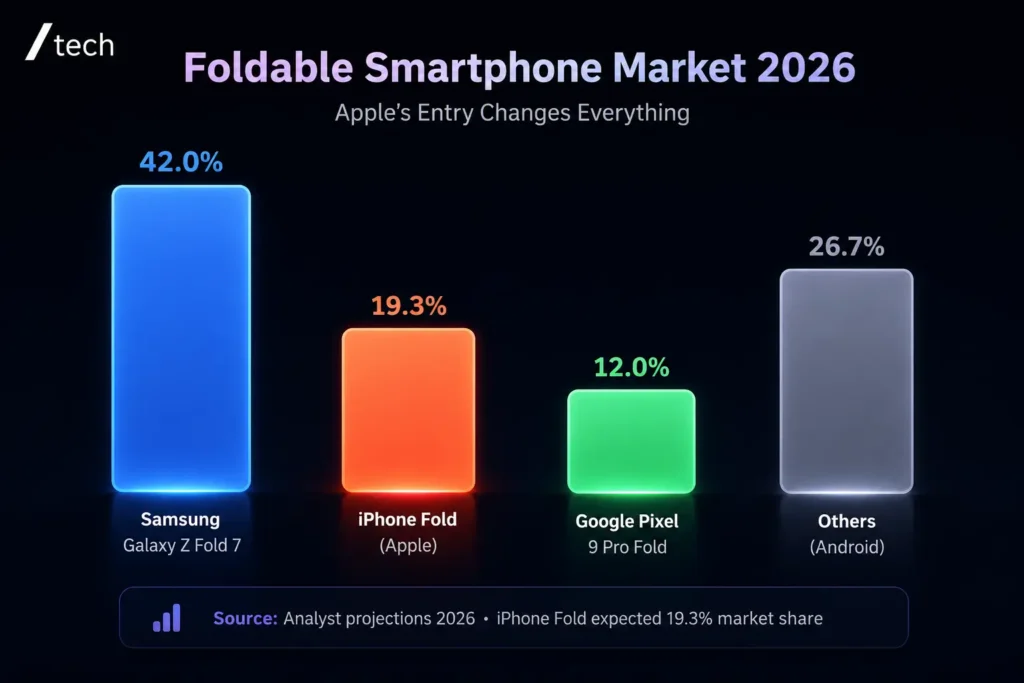
The introduction of Apple changes the entire dynamics of a category in which, for seven years, Samsung was dominant. That is a staggering 19.3 percent, given that it is the first-generation foldable.
The iPhone Fold is going to tangle with two of the most competitive alternatives in the Android foldable category: Samsung Galaxy Z Fold Series vs Google Pixel 9 Pro Fold. One thing under Apple’s umbrella is hardware and software, ranging from the Liquidmetal hinge and near-invisible crease, to the 4:3 inner display and foldable-optimized iOS 27. It’s an integrated product, not a list of specs. The contestants will have to react.
Whereas the Fold line will have an annual update, Apple expects another generation in 2027 that has registered compromises at the first generation due to Face ID, telephoto camera, and a still-growing ecosystem of apps.
Conclusion
The iPhone Fold is not an overnight creation wrought from the chops of Apple. It’s the culmination of years of targeted enhancements for the issues that gave previous fold-and-flat smartphones a sense of unfinished, such as the crease problem, hinge durability, battery, and software. To be sure, whether Apple will solve all of those issues remains to be seen once it gets to reviewers, but the evidence in the supply chain suggests it is a good product and not just an experiment.
If you’re a buyer looking for a single device with a phone capability and a small tablet, the iPhone Fold could be this iPhone. Others, however, immediately outline Apple’s first pivot of the foldable endeavors, and where they think the company’s loan of foldable will go next.
Must Explore: iPhone Fold vs Samsung Galaxy Z Fold 7 | Which Foldable Is Worth Your Money?
iPhone Fold Release Date Delayed? Supply Chain Leaks Explained 2026
CDiPhone | Real Meaning, Why It’s Trending & How to Play CDs on iPhone 2026
Frequently Asked Questions
What is the iPhone Fold?
The iPhone Fold is the first foldable smartphone offered by Apple, which will be released in fall 2026 as part of the iPhone 18 series. It adopts the book-style design, and has the inner display of a 7.76 “OLED screen and an outer display of a 5.49″ OLED screen. The name’s going to be officially changed to iPhone Ultra sometime soon.
When will it be released?
Apple is speculated to announce it in September 2026 along with the iPhone 18 Pro. The actual launch may be delayed to the end of 2026 or early 2027 to address supply issues.
How much will the iPhone Fold cost?
The base 256GB will be available for around $1,999 and will be the most expensive iPhone Apple has ever sold. The more expensive you go with Storage, the more you will pay.
Does the iPhone Fold have Face ID?
No. It features Touch ID with the side power button. Engineering constraints proved too hard for Apple in the first generation, as the ultra-thin profile would not allow for the installation of Face ID hardware in both displays.
Will it have a visible crease?
To make the crease as small as possible, Apple has designed a Liquidmetal hinge, optically clear adhesive display cushion, nin,g and transparent polyimide film. It is said to be close to “nearly invisible” as compared to the current Android foldables.
Does it run iOS or iPadOS?
iOS 27 is not iPadOS, it’s the version for the iPhone Fold. It offers split-screen multi-tasking and a large-screen optimised layout, but cannot be used with Apple Pencil, Stage Manager, or iPadOS-only apps.