
Apple’s new foldable phone is certainly one of the most anticipated handsets of the year so far. However, as the window for the announcement opens up again in September 2026, increasing signs of progress from the supply chain indicate that something is wrong with the flight path for the iPhone Fold. First mass production was originally scheduled for June 2026, but this target has slipped about eight weeks to August 2026. For customers following along in the windows lead-up and awaiting distribution, it is more important to know what really happened on the supply chain than the headlines.
This article explains each and every delay that happened, the cause, their present situation, and the effect of this on the production date of the iPhone Fold.
What Happened: The Official Timeline vs Reality
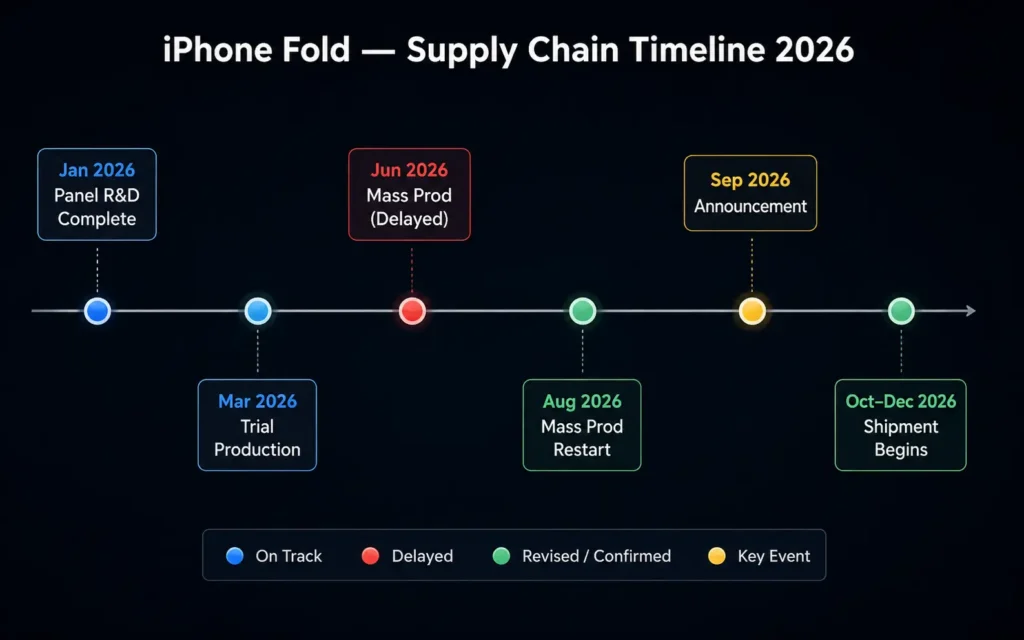
The preliminary roadmap of the first-generation iPhone Fold planned to run trial production at Foxconn all the way to March 2026, and then launch full-scale production in June. That would have provided Apple with a nice margin and time until September, when they would be ready to announce in time to conduct a more controlled rollout.
This buffer is no longer present. Indeed, Bloomberg’s Mark Gurman and analyst Ming-Chi Kuo have received confirmation from multiple sources in the supply chain that the chain goes like this:
Samsung Display has finished the development of the metal support panel (MSP) with a laser cut for the crease to match the requirements of Apple.
- Foxconn did trial assembly runs in March of 2026. The units were operational, but the precision with which the hinges are attached is not up to the Apple standard.
- The Quad-Polymerization method failed to crank up on time at mass production in June, 2026. The yield of OLED foldable panels was found to be lower than the range that Apple demanded.
- Products to be marketed in August for the mass production that will begin in August 2026. Foxconn and Samsung Display were able to solve some of the biggest yield problems. As of mid-2026, this timeline also continues to be on track, Gurman confirmed.
Supply Chain Timeline: Original vs Revised
| Phase | Original Timeline | Revised Timeline | Status |
|---|---|---|---|
| Panel R&D Complete | December 2025 | January 2026 | Complete |
| Trial Production (Foxconn) | March 2026 | March 2026 | Complete |
| Mass Production Start | June 2026 | August 2026 | Delayed |
| Apple Event / Announcement | September 2026 | September 2026 | On Track |
| First Customer Shipments | October 2026 | Oct–Dec 2026 | Likely |
| Full Production Scale-Up | Q4 2026 | Q1 2027 | Revised |
Root Cause: Why Did Mass Production Slip?
Mass production was delayed by three different engineering difficulties, delayed until August. None of these is issues inherent to any product Apple is making, but they just had to be resolved before volume manufacturing.
Foldable OLED Panel Yield Rate
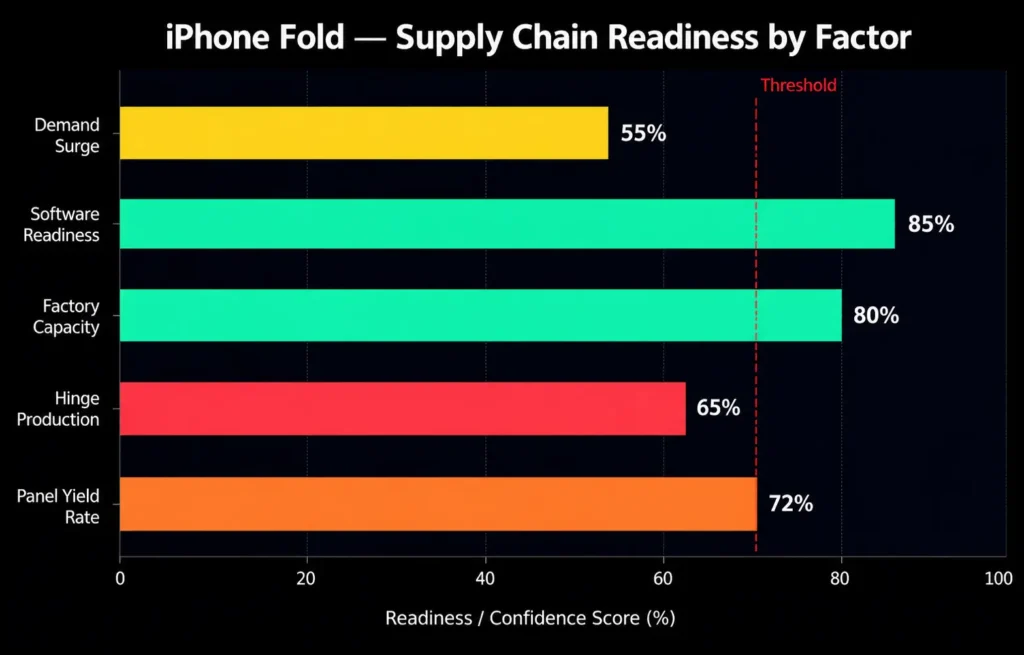
Samsung Display’s crease-minimizing panel folds over a metal support structure with laser holes to spread the mechanical force evenly over the surface, resulting in a higher yield rate. This was more difficult than the demonstration runs were optimistic, and could not be consistently produced at scale. The yield rates in Q1 2026 were tracking at ~65 %, which is significantly below Apple’s 80% rule. The yields were around 72 per cent, which is nearing the threshold for Apple to approve the August restart as they did in 2022, so there was no Q2 2026 poster chart.
Hinge Assembly Precision at Foxconn
The Liquid metal hinge Apple is utilizing is a ton more intricate to assemble than a customary telephone body. This is because there was a variance in hinge tension for early Foxconn production units, which were rejected by Apple’s quality control. More jig tooling and calibration were needed on the assembly line which increased the pre-production time by weeks.
Simultaneous iPhone 18 Production Pressure
Apple’s volume products (iPhone 18 and iPhone 18 Pro) are concurrently manufactured at Apple’s volume manufacturing facilities. The production capacity needed to be matched in assembly for the much trickier iPhone Fold, which did not slam down the launch of the flagship iPhone series, and took extra time due to its complicated design.
Risk Breakdown: What Could Still Go Wrong
| Risk Factor | Severity | Current Status | Impact on Launch |
|---|---|---|---|
| Foldable Panel Yield Rate | High | Improving — 72% yield Q2 2026 | Could limit Day 1 units |
| Hinge Assembly Precision | High | Foxconn trial runs complete | Resolved for mass production |
| Mass Prod Delay (Jun → Aug) | High | Confirmed — 8-week slip | Shipments pushed to Oct+ |
| Software (iOS 27) Readiness | Medium | On track per Gurman | Minimal risk |
| Component Shortages | Medium | C2 modem supply stable | Low risk currently |
| Demand Surge / Pre-orders | Medium | 20M display units ordered | Supply still tight |
| Geopolitical / Trade Risk | Low-Medium | No active disruptions | Watch Q4 2026 |
What the Analysts Are Saying
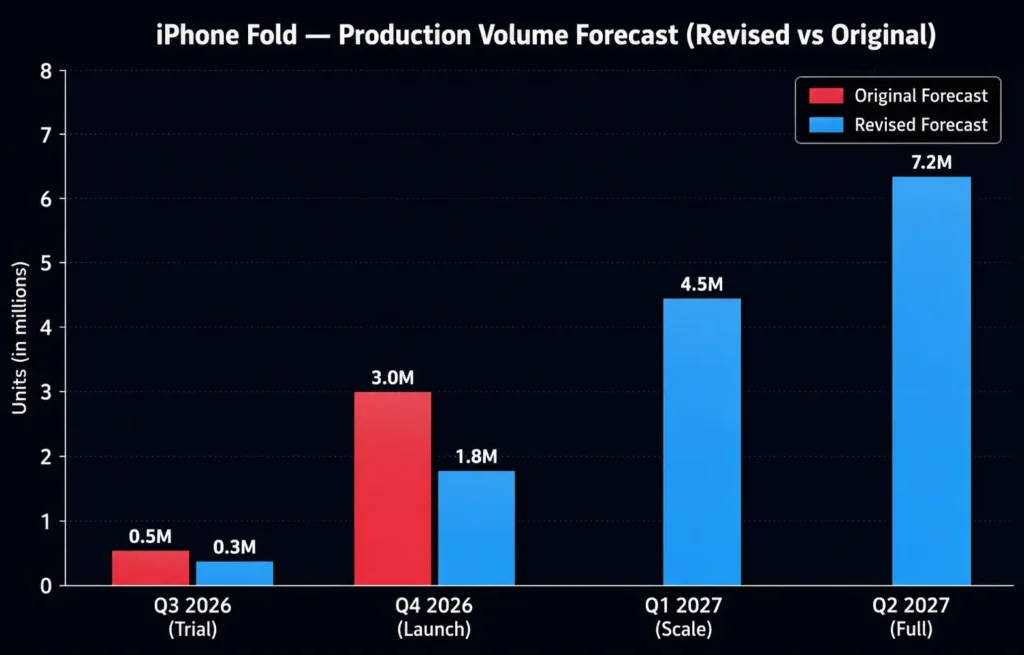
Supply Chain analyst Ming-Chi Kuo has been the most specific with his volume forecasts. His new estimate now pegs initial 2026 deliveries at 3-5 million units compared to previous estimates of 6-8 million. The panel yield constraints and the new production starting in August are the only reasons for the reduction, says Kuo. The 2027 ramp is, however, still mostly intact as Kuo estimates its market share to be between 15 and 18 million units once the ramp is full.
To address concerns over yield related to the initial display panels, Apple ordered an extra 20 million units from Samsung Display in Q1 2026, viewed as a buffer to mitigate losses and as a sign of confidence in the demand for the display panels. More than panic, it was an aggressive inventory positioning, according to industry analyst Jeff Pu of Haitong International.
What This Means for Buyers: Should You Be Worried?
Production delay is different from a product issue. The causes of the iPhone Fold slip are both quality-based. Apple’s production delay was due to the fact that it will not ship units that fall below its standards. This is exactly what Apple customers are expecting from them.
What the delay does mean practically:
- Limited inventory of day 1. But Apple won’t have as thicker its inventory after launching production in August, and should see sales in October as early as possible, with limited months for accumulation. The sell-outs for pre-order are very likely to happen within a few hours of the launch.
- Units may not be available to some buyers until early 2027. Some of the pre-orders made on launch are expected to ship in January or February of 2027, based on the demand and speed of Foxconn.
- The product is not harmed. All signs from the supply chain are that Apple sorted the quality problems out before sending them to mass production. The delay was to do with volume, not with the overall quality of the device.
How Does This Compare to Previous Apple Launch Delays?
It’s not Apple’s first failed launch. As a result of COVID-19 supply chain delays, the iPhone 12 was released in October and November 2020, which is slightly behind the typical September launch. AirPods Max withstood the challenge of a heavy shortage of supply in December 2020 and was released on a very limited scale. It’s probably significant that Apple introduced the Apple Vision Pro at one million units, purposefully set to undersell supply.
The iPhone Fold delay is within Apple’s normal tolerance for something as complicated as the first-generation fold phone. The comparison is most illuminating with the Vision Pro: Apple released its first-generation VR smart cap with recognized limitations, carefully managed its supply contracts and spent the first couple of years tweaking its hardware and software to get it just right before making it widely available. It appears that this pattern is going to be repeated with the iPhone Fold: limited market uptake in 2026 before it reaches significant scale in 2027.
To learn more about the specification and the display technology used, check out our iPhone Fold complete guide. To compare this to Samsung’s folding handset, check out the iPhone Fold vs Samsung Galaxy Z Fold 7 comparison.
Explore Now: CDiPhone | Real Meaning, Why It’s Trending & How to Play CDs on iPhone 2026
iPhone Fold vs Samsung Galaxy Z Fold 7 | Which Foldable Is Worth Your Money?
Samsung Galaxy A56 Review: Is It Still Worth Buying in 2026?
How to Fix a Chipped Phone Screen: Repair Options, Costs, and Prevention
iPhone Fold vs Samsung Galaxy Z Fold 7 | Which Foldable Is Worth Your Money?
iPhone Fold | Everything You Need to Know Design, Specs, Price, and Release Date 2026
iPhone Fold vs Samsung Galaxy Z Fold 7
FAQ’s
Is the iPhone Fold launch cancelled or significantly delayed?
No. The announcement at Apple’s September 2026 event remains confirmed per Bloomberg’s Mark Gurman. What shifted is the mass production start from June to August 2026 which moves first customer shipments to October through December 2026 rather than September.
Why was iPhone Fold’s mass production delayed?
No. Bloomberg’s Mark Gurman confirms the announcement at Apple’s Sept. 2026 event. The other change is the start of mass production, which was scheduled for June-August 2026, but has been pushed back to October-December 2026.
How many iPhone Fold units will be available at launch?
Ming-Chi Kuo estimates 3 to 5 Ming-Chi Kuo believes 3-5 million units will be sold in 2026 (down from the original 6-8 million forecast).
Will the delay affect iPhone Fold quality?
No. Apple did not allow the August mass production to begin until the yield and assembly accuracy problems were fixed to Apple standards. The delay was quality-centric Apple left nothing unshipped that it did not believe met its quality standards.
When should I pre-order the iPhone Fold?
The campaign will start right after the September 2026 Apple event. With limited inventory during Day 1, it’s advisable to secure your copy as soon as possible if you’ll need it by 2026.
Will supply improve in 2027?
Yes, substantially. As Foxconn increases its capacity and panel yields are above Apple’s level, Kuo also sees 15 to 18 million units in 2027.